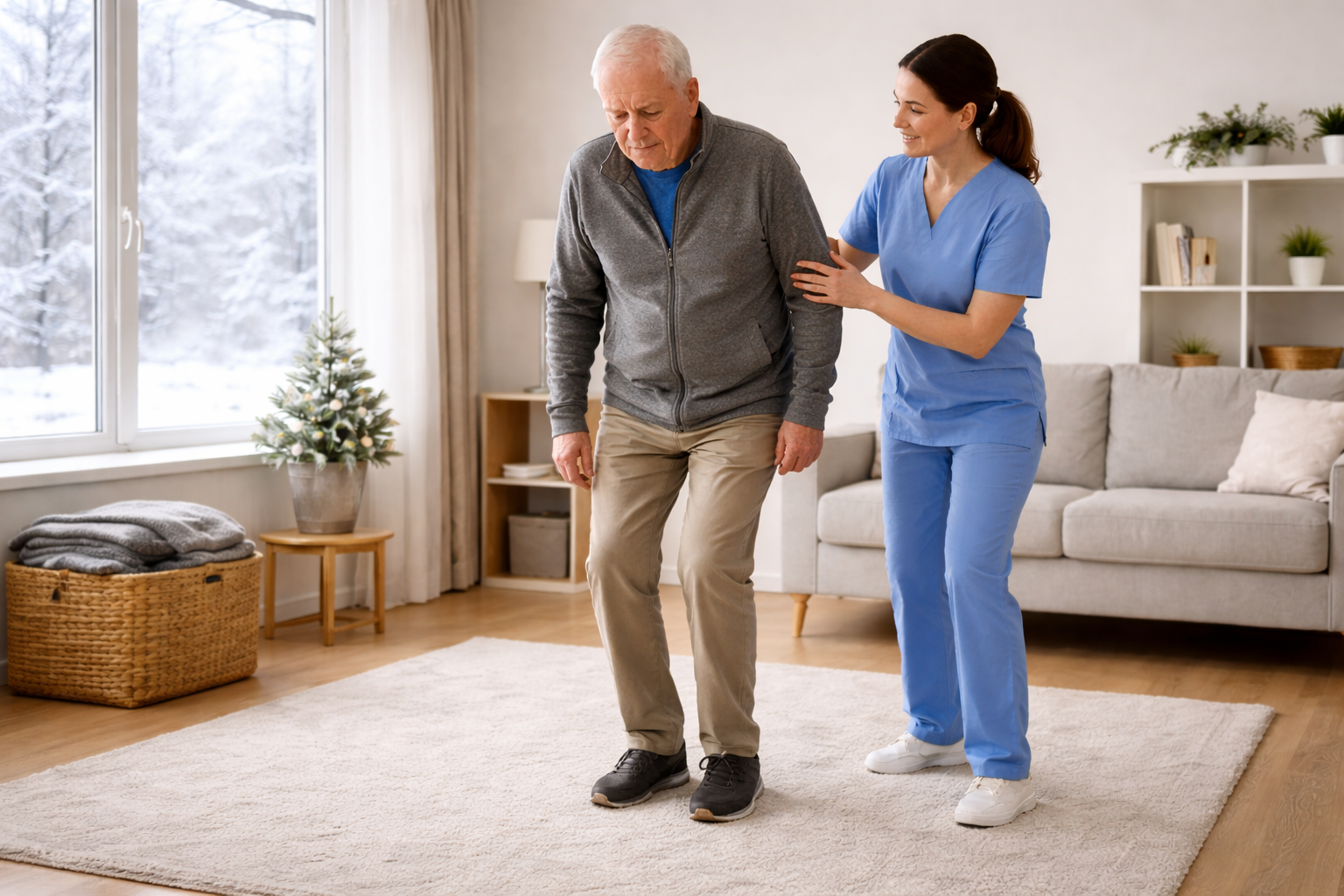
For many people living with Parkinson’s disease, winter brings more than cold weather. It often brings worsening mobility, increased hesitation when walking, and more frequent episodes of freezing of gait.
If you or a loved one notice more difficulty starting steps, turning, or walking through doorways during the winter months, there’s a reason — and physical therapy can help.
What Is Freezing of Gait?
Freezing of gait (FOG) is a sudden, brief inability to move the feet forward despite the intention to walk. People often describe it as feeling like their feet are “glued to the floor.”
Freezing commonly occurs:
- When starting to walk
- While turning
- Approaching doorways or tight spaces
- In crowded or distracting environments
It’s one of the most challenging Parkinson’s symptoms and a major contributor to falls.
External source:
https://www.parkinson.org/understanding-parkinsons/movement-symptoms/freezing
Why Freezing of Gait Worsens in Winter
1. Cold Increases Muscle Stiffness
Cold temperatures increase muscle rigidity — a core Parkinson’s symptom. When muscles are stiffer, movement initiation becomes harder, making freezing episodes more likely.
2. Reduced Activity Leads to Deconditioning
People tend to move less in winter. Less movement leads to:
- Reduced strength
- Slower reaction time
- Decreased confidence
All of these factors increase freezing frequency.
Internal link:
[Why Winter Falls Spike After the Holidays — and How to Reduce Your Risk](internal link to published blog)
3. Heavier Clothing Restricts Movement
Bulky coats, boots, and layers can alter posture and gait mechanics, making already challenging movements even harder for individuals with Parkinson’s.
4. Increased Fear of Falling
Slippery surfaces and winter conditions increase fear — and fear is a major trigger for freezing. The brain hesitates, and the body follows.
Internal link:
[How Physical Therapy Helps You Regain Confidence After a Near-Fall](upcoming internal link)
5. Fatigue and Stress
Shorter daylight hours, disrupted routines, and holiday stress all worsen Parkinson’s symptoms, including freezing of gait.
Why Freezing of Gait Is Dangerous
Freezing episodes significantly increase fall risk because:
- Balance reactions are delayed
- Sudden stops disrupt posture
- People may rush to “break” the freeze
According to the National Institute on Aging, gait disturbances are a leading cause of falls in neurological conditions.
External source:
https://www.nia.nih.gov/health/prevent-falls-and-fractures
How Physical Therapy Helps Manage Freezing of Gait
1. Cueing Strategies
Physical therapists teach visual, auditory, and movement cues that help bypass freezing, such as:
- Step counting
- Visual floor markers
- Rhythm-based walking
2. Gait Retraining
Therapy focuses on:
- Increasing step length
- Improving posture
- Practicing safe turns
- Reducing hesitation during transitions
Internal link:
How Physical Therapy Helps Improve Gait and Balance as You Age
3. Balance and Reaction Training
Targeted balance exercises help the body respond faster when freezing occurs, reducing fall risk.
4. Parkinson’s-Specific Movement Programs
Our Parkinson’s Disease Treatment Programs use evidence-based approaches to improve mobility, confidence, and safety — even during challenging seasons.
When to Seek Help
You should consider physical therapy if freezing:
- Happens more often in winter
- Occurs during turns or in doorways
- Leads to near-falls
- Causes fear or avoidance of walking
Early intervention can significantly reduce freezing frequency and severity.
Stay Mobile Through the Winter
Freezing of gait doesn’t have to control your movement — even in cold weather. With the right strategies and support, many people see meaningful improvement in confidence and walking ability.
Schedule a Parkinson’s Mobility Evaluation
📍 Synaptic Rehabilitation
1200 Route 22 East, Suite 4
Bridgewater, NJ 08807
📞 Call: 908-801-6425