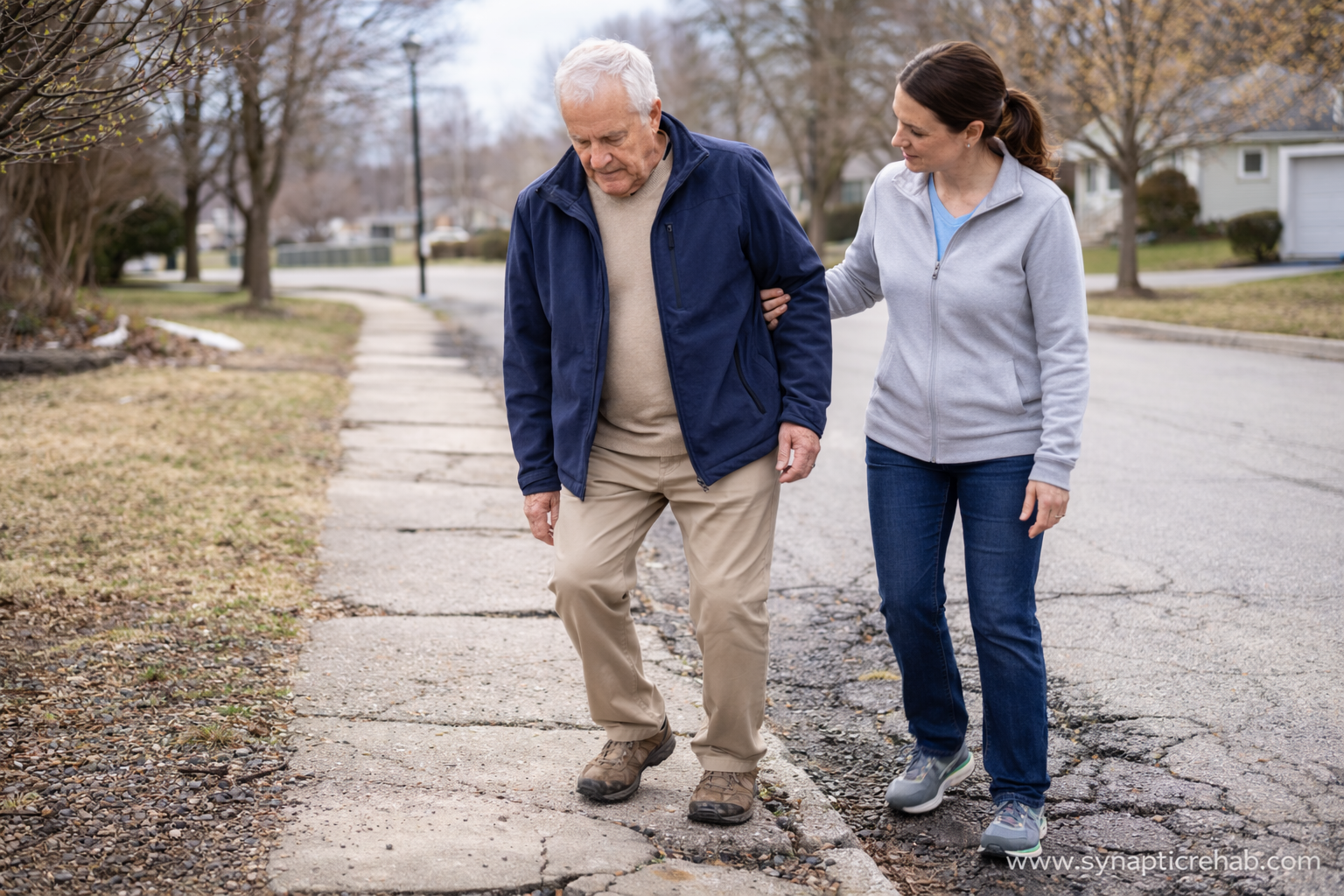
As winter fades, many people feel ready to get outside again. But early spring brings a hidden risk: uneven, unstable ground.
Melting snow, cracked pavement, potholes, loose gravel, and wet sidewalks create unpredictable walking conditions. For older adults and individuals with Parkinson’s disease, these surface changes significantly increase fall risk.
The challenge isn’t just the ground. It’s how your body responds to it.
Why Uneven Surfaces Are So Challenging
Walking on flat indoor flooring is predictable. Outdoor terrain isn’t.
Uneven ground requires your body to:
- Adjust foot placement quickly
- Shift weight rapidly
- React to unexpected changes
- Maintain balance during single-leg stance
- Coordinate vision with movement
If strength or balance reactions are slowed, the risk of stumbling increases.
What Makes Early Spring Especially Risky
1. Surface Instability
Melting ice leaves:
- Soft ground
- Wet pavement
- Mud
- Hidden potholes
Traction becomes inconsistent, even when surfaces look safe.
External source:
https://www.cdc.gov/falls
2. Deconditioning After Winter
Many people move less during colder months. Reduced activity leads to:
- Weaker hip and leg muscles
- Slower balance reactions
- Decreased endurance
Internal link:
[Why Sitting Too Much Is Worse for Balance Than You Think](internal link to published blog)
3. Reduced Confidence Outdoors
After winter slips or near-falls, people often walk more cautiously outside. This can lead to shorter steps and stiffness — which actually decreases stability.
Internal link:
[How Physical Therapy Helps You Regain Confidence After a Near-Fall](internal link to published blog)
4. Turning on Uneven Ground
Changing direction outdoors is harder than indoors. Gravel, grass, or cracked pavement increases instability during turns.
Internal link:
[Why Turning Is Harder Than Walking Straight — and How Physical Therapy Helps](internal link to published blog)
Why Falls Often Happen Outdoors
Outdoor falls frequently occur because:
- Surfaces are unpredictable
- Lighting varies
- The body must react faster
- Foot clearance is reduced
According to the National Institute on Aging, environmental hazards are a major contributor to falls in older adults.
External source:
https://www.nia.nih.gov/health/prevent-falls-and-fractures
How Physical Therapy Prepares You for Real-World Surfaces
1. Strengthening for Stability
Therapy strengthens the hips, thighs, and core — the muscles responsible for stabilizing the body when terrain changes.
2. Balance Training on Variable Surfaces
Physical therapy can incorporate:
- Dynamic balance drills
- Direction changes
- Surface variability training
Internal link:
How Physical Therapy Helps Improve Gait and Balance as You Age
3. Gait Retraining
Improving step length, foot clearance, and posture reduces tripping risk on uneven ground.
4. Parkinson’s-Specific Outdoor Strategies
For individuals with Parkinson’s disease, uneven ground may worsen freezing or hesitation.
Our Parkinson’s Disease Treatment Programs include strategies for navigating outdoor environments safely.
External source:
https://www.parkinson.org/understanding-parkinsons/movement-symptoms
Signs You Should Address Outdoor Stability
Consider physical therapy if:
- You avoid walking outdoors
- Grass or gravel feels unstable
- You feel hesitant stepping off curbs
- You’ve had near-falls outside
- You feel less confident walking in your neighborhood
Early intervention prevents small outdoor challenges from becoming serious injuries.
Spring Should Mean Freedom — Not Fear
Getting outside is important for physical and mental health. The right preparation ensures uneven ground doesn’t limit your independence.
Schedule a Balance & Mobility Evaluation
📍 Synaptic Rehabilitation
1200 Route 22 East, Suite 4
Bridgewater, NJ 08807
📞 Call: 908-801-6425