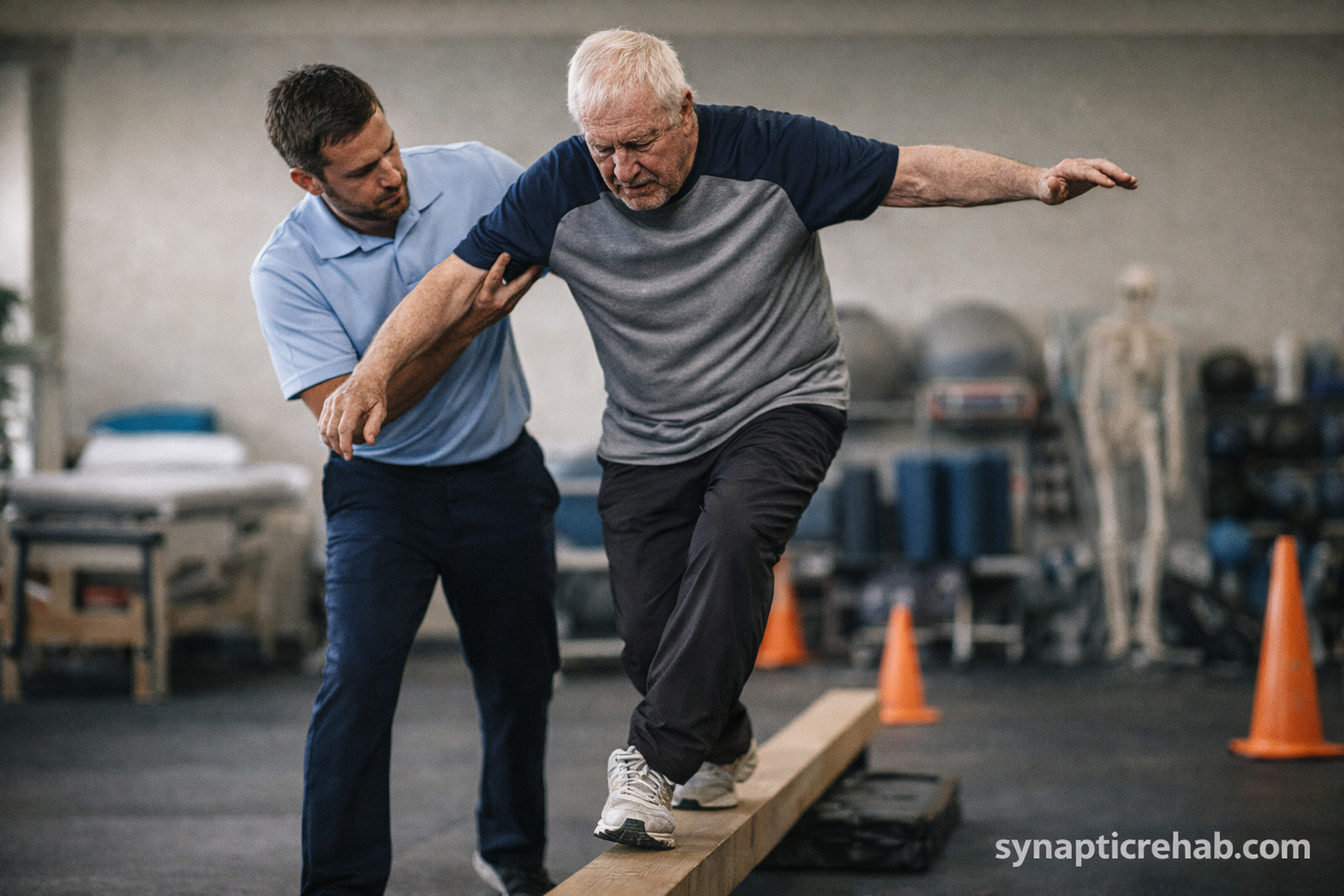
Many people assume balance problems are caused by weakness.
But here’s something most don’t realize: you can be strong and still be at risk of falling when you’re fatigued.
Fatigue affects the brain, reaction time, coordination, and posture — all critical components of balance. And for older adults and individuals with Parkinson’s disease, fatigue can significantly increase fall risk.
What Fatigue Actually Does to Your Balance
Balance isn’t just muscular. It’s neurological.
When you’re fatigued:
- Reaction time slows
- Muscle activation becomes less precise
- Posture becomes less controlled
- Step timing becomes inconsistent
- Attention decreases
Even small delays in reaction time can mean the difference between recovering from a stumble and falling.
External source:
https://www.cdc.gov/falls
Physical Fatigue vs. Brain Fatigue
1. Muscle Fatigue
When muscles are tired, they generate less force and respond slower. This makes:
- Climbing stairs harder
- Turning less controlled
- Standing from a chair more unstable
Internal link:
[Why Getting Up From a Chair Gets Harder With Age — and How Physical Therapy Fixes It](internal link to published blog)
2. Neurological (Central) Fatigue
This is the more overlooked factor.
Neurological fatigue affects:
- Coordination
- Processing speed
- Balance reactions
- Dual-task performance
That’s why falls often happen:
- Later in the day
- After long outings
- When multitasking
- During periods of stress
Why Fatigue Is More Significant in Parkinson’s
Fatigue is one of the most common non-motor symptoms of Parkinson’s disease.
It can worsen:
- Freezing episodes
- Slowness of movement
- Postural instability
External source:
https://www.parkinson.org/understanding-parkinsons/non-movement-symptoms/fatigue
Internal link:
Parkinson’s Disease Treatment Programs
Warning Signs Fatigue Is Affecting Your Balance
You may notice:
- Feeling steady in the morning but unsteady at night
- Slower walking later in the day
- Increased stumbling when tired
- More hesitation during turns
Internal link:
[Why Turning Is Harder Than Walking Straight — and How Physical Therapy Helps](internal link to published blog)
How Physical Therapy Improves Balance Under Fatigue
1. Endurance Training
Physical therapy builds cardiovascular and muscular endurance so fatigue sets in later — and impacts balance less.
2. Reaction Time Training
Targeted drills improve how quickly the body responds when balance is challenged.
Internal link:
How Physical Therapy Helps Improve Gait and Balance as You Age
3. Dual-Task Training
Therapists train balance while performing cognitive tasks. This improves stability when attention is divided — especially during fatigue.
4. Energy Conservation Strategies
For individuals with Parkinson’s or chronic fatigue, therapy includes pacing strategies to maintain safety throughout the day.
Strength Alone Isn’t Enough
You can have good muscle strength and still be at risk if your balance system is fatigued.
Addressing endurance, reaction time, and neurological control is what keeps balance consistent — not just strong.
When to Seek Help
Consider a balance evaluation if:
- You feel more unsteady as the day goes on
- Falls or near-falls happen when tired
- You avoid activity because of fatigue
- You have Parkinson’s and notice worsening balance later in the day
Early intervention improves both safety and confidence.
Schedule a Balance & Endurance Evaluation
📍 Synaptic Rehabilitation
1200 Route 22 East, Suite 4
Bridgewater, NJ 08807
📞 Call: 908-801-6425