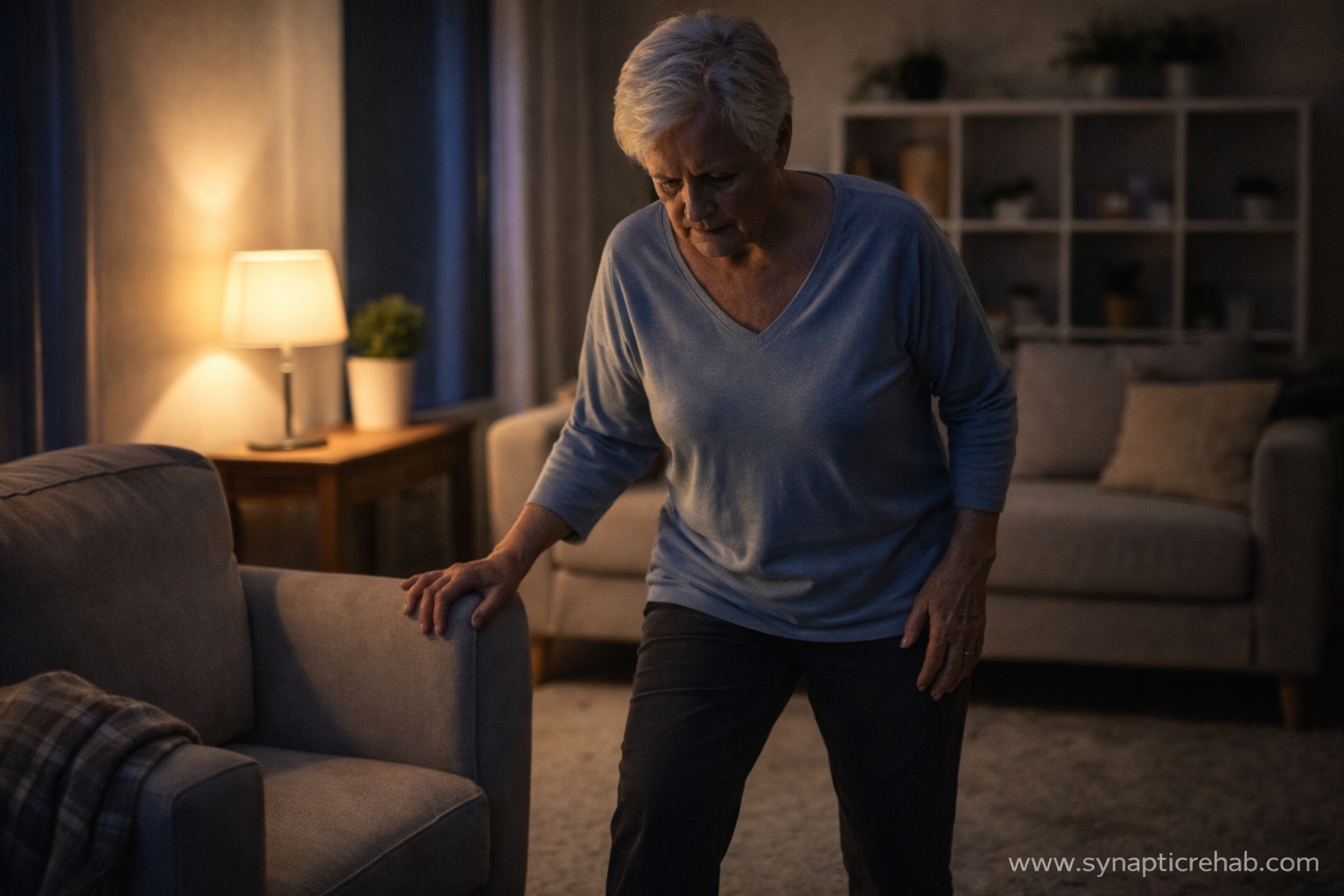
Have you ever noticed that walking feels harder at night?
Maybe you feel less steady going to the bathroom in the dark. Or uneven surfaces seem more challenging in dim lighting.
That’s not your imagination.
Your balance system relies heavily on vision. When lighting decreases, your stability can decrease too — especially as you age or if you have a neurological condition like Parkinson’s disease.
Balance Is a Three-System Process
Your body maintains balance using three main systems:
- Vision – Tells you where you are in space
- Inner ear (vestibular system) – Detects head movement
- Proprioception – Senses joint and body position
When one system becomes less reliable, the others must compensate.
In dim lighting, your visual system provides less accurate information — forcing your brain to rely more heavily on the other two systems.
External source:
https://www.nia.nih.gov/health/prevent-falls-and-fractures
Why Vision Becomes Even More Important With Age
As we age:
- Reaction time slows
- Muscle strength decreases
- Proprioception becomes less precise
- Depth perception changes
Because of this, many older adults become more visually dependent for balance.
When lighting is reduced, stability can decline quickly.
Internal link:
How Physical Therapy Helps Improve Gait and Balance as You Age
Why Nighttime Is a High-Risk Period for Falls
Falls commonly occur:
- During nighttime bathroom trips
- In dim hallways
- On poorly lit staircases
- Outdoors at dusk
According to the CDC, falls are a leading cause of injury among older adults, and environmental factors significantly contribute to fall risk.
External source:
https://www.cdc.gov/falls
Low lighting increases risk because:
- Obstacles are harder to detect
- Contrast perception decreases
- Step depth is misjudged
- Reaction time slows
Dim Lighting and Parkinson’s Disease
For individuals with Parkinson’s disease, reduced lighting can worsen:
- Freezing of gait
- Hesitation when turning
- Shuffling patterns
- Postural instability
External source:
https://www.parkinson.org/understanding-parkinsons/movement-symptoms
Internal link:
Parkinson’s Disease Physical Therapy in Bridgewater, NJ
When visual cues are limited, movement can become less automatic and more cautious — increasing instability.
Signs Your Balance Is Visually Dependent
You may notice:
- Feeling steady during the day but unsteady at night
- Grabbing walls in dim areas
- Hesitating on dark stairs
- Increased fear of falling in low-light settings
If this sounds familiar, your balance system may need strengthening beyond visual reliance.
How Physical Therapy Reduces Visual Dependence
1. Balance Training With Reduced Visual Input
Therapists may incorporate exercises that safely challenge balance with eyes closed or reduced lighting to strengthen proprioceptive and vestibular systems.
2. Reaction Time Drills
Improving neuromuscular response helps your body recover more quickly when balance is challenged.
Internal link:
[How Physical Therapy Helps You Regain Confidence After a Near-Fall](internal link to published blog)
3. Gait and Posture Correction
Improved posture and step mechanics reduce reliance on visual compensation.
4. Home Safety Recommendations
Small adjustments can significantly reduce nighttime fall risk:
- Motion-sensor night lights
- Clear pathways
- High-contrast stair edges
- Proper footwear
Balance Shouldn’t Disappear When the Lights Go Down
If your stability changes noticeably in dim lighting, it’s an early warning sign — not something to ignore.
Improving balance now reduces fall risk before an injury occurs.
Schedule a Balance Evaluation
📍 Synaptic Rehabilitation
1200 Route 22 East, Suite 4
Bridgewater, NJ 08807
📞 Call: 908-801-6425
If walking feels different at night, it’s time to strengthen the systems that keep you steady — even in the dark.