
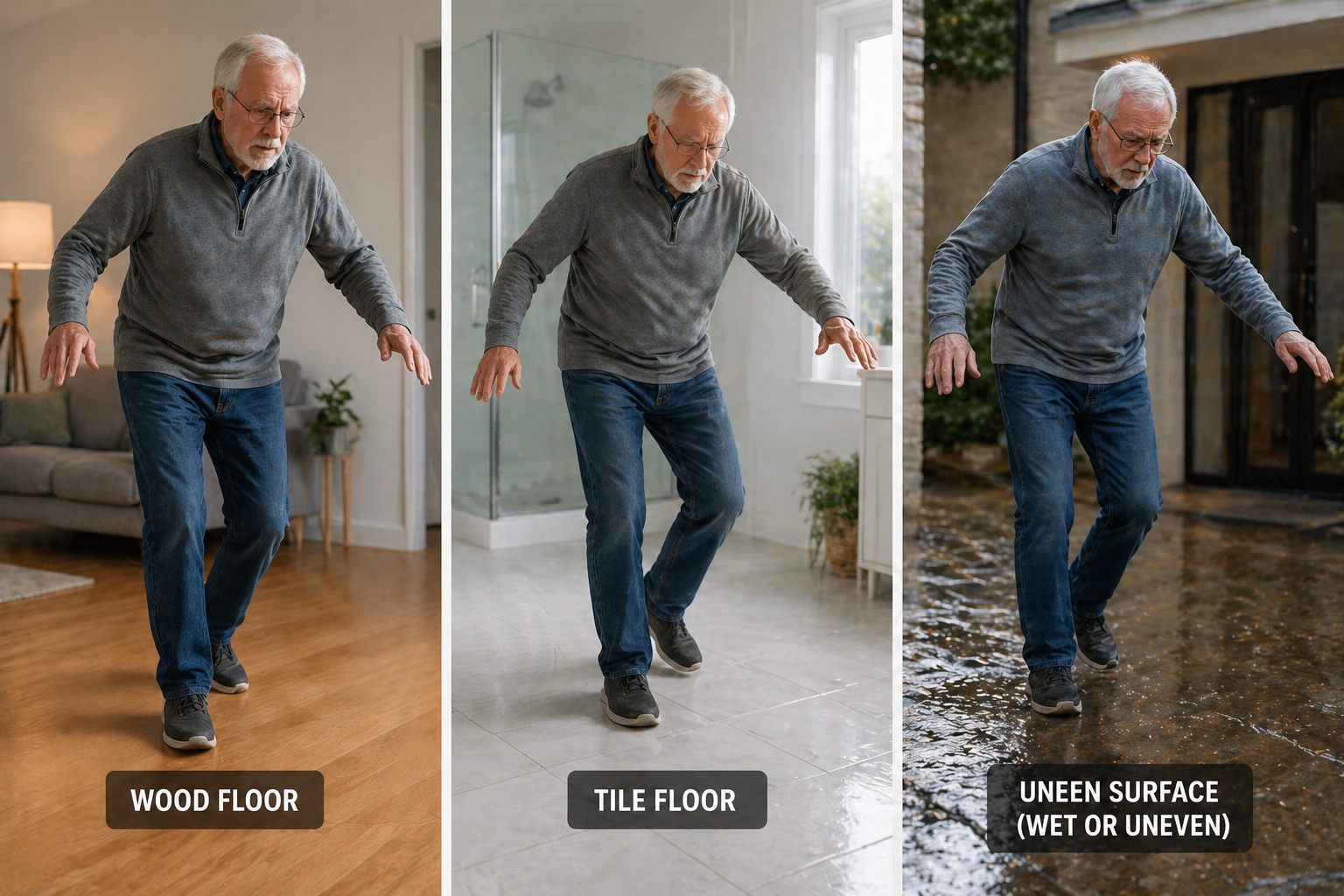
Why Your Balance Changes on Different Floor Surfaces
Have you ever noticed that you feel more stable on one surface than another?
Maybe carpet feels easier than hardwood.
Or tile feels slippery.
Or uneven ground feels unpredictable.
That’s not random.
Your balance system responds differently depending on the surface beneath your feet — and those differences can significantly affect your stability.
Your Feet Are Constantly Sending Information to Your Brain
Balance isn’t just about strength. It’s also about sensory feedback.
Your feet detect:
- Pressure
- Texture
- Firmness
- Movement
This information helps your brain adjust posture and movement in real time.
When the surface changes, that feedback changes too.
External source:
https://www.nia.nih.gov/health/balance-problems-and-falls
How Different Surfaces Affect Balance
1. Carpet (Soft Surfaces)
Carpet can feel more comfortable — but it absorbs force and reduces feedback.
This can:
- Make it harder to sense foot position
- Slow reaction time
- Increase instability during movement
2. Hardwood or Tile (Firm Surfaces)
Firm surfaces provide more consistent feedback, but they can feel:
- Harder underfoot
- More slippery
- Less forgiving if balance is lost
Learn more: https://synapticrehab.com/why-you-feel-more-unsteady-in-dim-lighting-and-what-it-means-for-your-balance/
3. Uneven Surfaces (Outdoors)
Grass, gravel, and cracked pavement require constant adjustment.
These surfaces:
- Change with every step
- Reduce predictability
- Increase demand on balance reactions
Learn more: https://synapticrehab.com/why-uneven-ground-becomes-more-dangerous-in-early-spring/
4. Transitional Surfaces
Moving from one surface to another — like carpet to tile — can be especially challenging.
Your brain must quickly adapt to new sensory input.
Why Surface Changes Increase Fall Risk
Surface variation affects:
- Foot placement accuracy
- Reaction time
- Stability during transitions
- Confidence while walking
Even small changes can disrupt balance if your system isn’t adapting efficiently.
Learn more: https://synapticrehab.com/why-small-trips-happen-before-big-falls-and-what-theyre-telling-you/
Why This Becomes More Noticeable With Age
As we age:
- Sensory feedback from the feet decreases
- Reaction time slows
- Balance becomes more visually dependent
This makes adapting to new surfaces more difficult.
Learn more: https://synapticrehab.com/why-you-feel-more-unsteady-in-dim-lighting-and-what-it-means-for-your-balance/
Floor Surfaces and Parkinson’s Disease
For individuals with Parkinson’s disease, surface changes can increase:
- Hesitation
- Freezing episodes
- Instability during walking
- Difficulty adjusting step length
External source:
https://www.parkinson.org/understanding-parkinsons/movement-symptoms
Learn more: https://synapticrehab.com/parkinsons-disease-physical-therapy-in-bridgewater-nj/
Common Situations Where This Happens
- Walking from carpet to tile in the kitchen
- Entering a bathroom with smooth flooring
- Stepping outside onto grass or pavement
- Moving between rooms with different flooring
These transitions are often where missteps occur.
Warning Signs to Watch For
- Feeling less stable on certain surfaces
- Slowing down when transitioning between floors
- Looking down more often while walking
- Avoiding certain areas of your home
These are signs your balance system is working harder than it should.
How Physical Therapy Helps
1. Sensory & Balance Training
Improves how your body processes feedback from different surfaces.
2. Dynamic Balance Exercises
Trains your ability to adapt to changing environments.
Learn more: https://synapticrehab.com/how-physical-therapy-can-help-improve-gait-and-balance-as-you-age/
3. Gait Training
Improves foot placement and walking consistency across surfaces.
4. Real-World Movement Training
Includes practicing transitions between surfaces safely.
Your Environment Matters More Than You Think
Balance isn’t just about your body — it’s about how your body interacts with your environment.
If different surfaces affect your stability, it’s a sign your balance system needs support.
Schedule a Balance & Mobility Evaluation
📍 Synaptic Rehabilitation
1200 Route 22 East, Suite 4
Bridgewater, NJ 08807
📞 Call: 908-801-6425
If certain floors or surfaces make you feel less steady, physical therapy can help you adapt, improve stability, and move confidently anywhere.

Steven Cheung, DPT
Steven is the founder and lead physical therapist at SYNAPTIC Rehabilitation. He earned a BS in Exercise Science Applied Kinesiology from Rutgers University in New Brunswick, NJ and his Doctorate degree from American International College in Springfield, MA. Steven specializes in movement disorders such as Parkinson’s disease and many other neurological disorders. Outside of practicing physical therapy Steven enjoys time with his wife, running, and staying active.