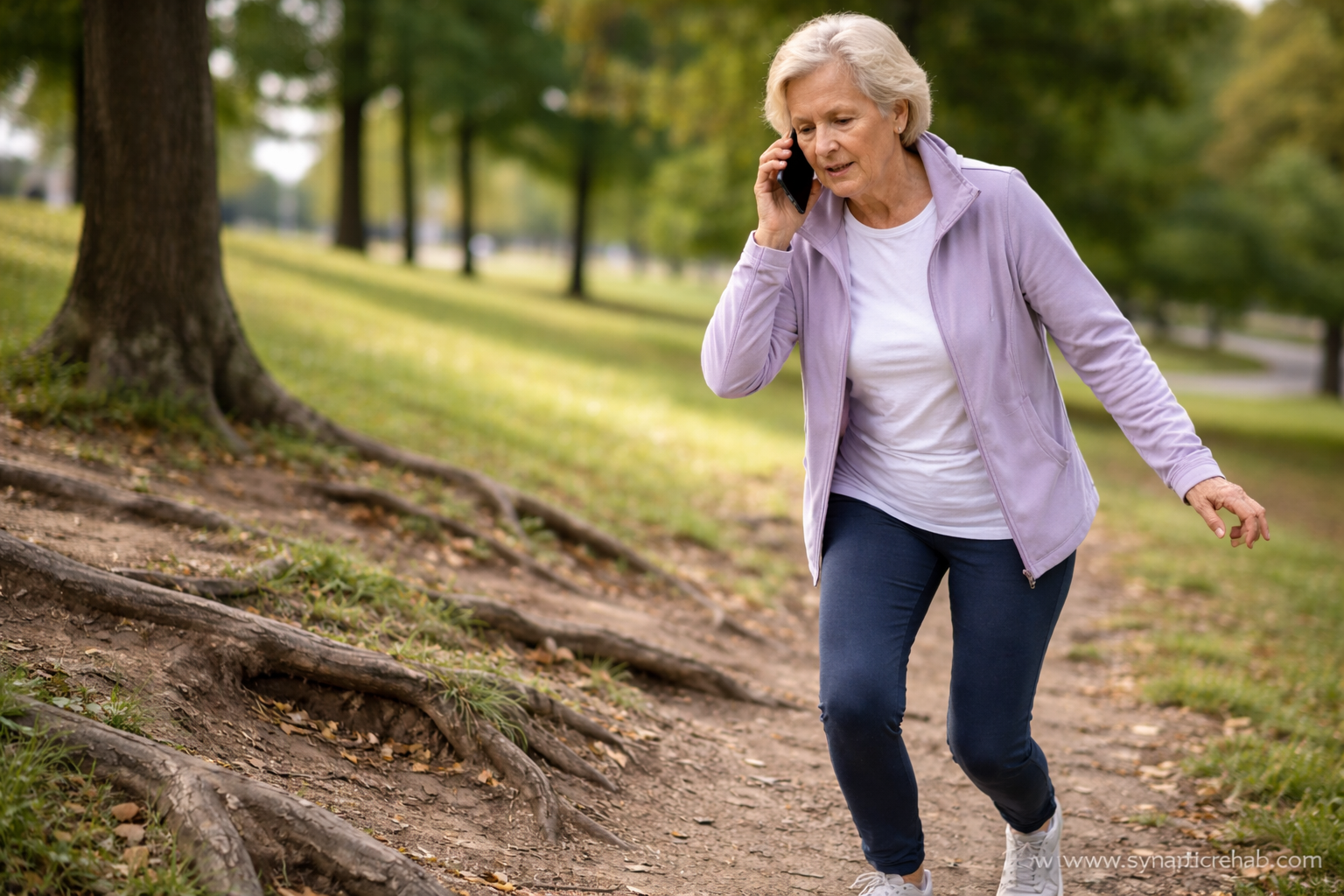
Most people think walking is automatic.
But when you add another task — like talking, thinking, or looking at your phone — walking suddenly becomes much harder for the brain to manage.
This is known as dual-task walking, and it plays a bigger role in fall risk than many people realize.
For older adults and individuals with Parkinson’s disease, dividing attention between movement and conversation can significantly increase the chance of stumbling or losing balance.
What Is Dual-Task Walking?
Dual-task walking occurs when your brain must handle two tasks at the same time, such as:
- Walking and talking
- Walking while thinking about directions
- Walking while carrying items
- Walking while looking around or scanning the environment
While these activities feel simple, they require coordination between multiple brain systems.
When the brain divides its attention, walking mechanics often change.
External source:
https://www.cdc.gov/falls
How Talking Changes the Way You Walk
When a conversation begins while walking, many people unknowingly experience:
- Slower walking speed
- Shorter steps
- Reduced arm swing
- Delayed reaction time
- Less stable posture
Your brain prioritizes the cognitive task — the conversation — and walking becomes less automatic.
Why This Matters for Fall Risk
Balance requires constant adjustments.
Your brain must process:
- Visual input
- Body position
- Ground conditions
- Obstacles
- Movement timing
When attention is divided, these adjustments may occur more slowly.
Even a slight delay can increase the risk of tripping or stumbling.
Internal link:
[Why Small Trips Happen Before Big Falls — and What They’re Telling You](internal link to published blog)
Dual-Task Challenges in Parkinson’s Disease
Dual-task situations are particularly difficult for people with Parkinson’s disease.
Parkinson’s can affect the brain’s ability to automate movement. This means walking requires more conscious attention.
When another task is added — such as conversation — it can lead to:
- Slower movement
- Freezing episodes
- Loss of rhythm while walking
- Increased fall risk
External source:
https://www.parkinson.org/understanding-parkinsons/movement-symptoms
Internal link:
Parkinson’s Disease Physical Therapy in Bridgewater, NJ
Common Real-World Situations Where Falls Happen
Dual-task balance problems often appear in everyday situations like:
- Talking while walking through a hallway
- Walking while greeting someone
- Turning while answering a question
- Carrying groceries while speaking
These distractions may seem small but can significantly affect stability.
Internal link:
[How Physical Therapy Helps You Regain Confidence After a Near-Fall](internal link to published blog)
How Physical Therapy Improves Dual-Task Walking
Physical therapy doesn’t just train muscles — it trains the brain and body to work together.
Treatment may include:
1. Gait Training
Improving walking mechanics so movement becomes more automatic.
Internal link:
How Physical Therapy Helps Improve Gait and Balance as You Age
2. Dual-Task Balance Exercises
Therapists safely practice walking while performing cognitive tasks such as counting, conversation, or problem-solving.
This improves coordination between thinking and movement.
3. Reaction Time Training
Improves the body’s ability to respond quickly when balance is challenged.
4. Parkinson’s-Specific Movement Strategies
For individuals with Parkinson’s disease, therapy may include cueing techniques and rhythm training to maintain walking stability.
Internal link:
Parkinson’s Disease Treatment Programs
When to Seek Help
You may benefit from a gait and balance evaluation if:
- You feel less steady when talking while walking
- You stop walking when someone speaks to you
- You’ve stumbled while multitasking
- Walking feels less automatic than it used to
These are common early signs that balance systems need strengthening.
Schedule a Gait & Balance Evaluation
📍 Synaptic Rehabilitation
1200 Route 22 East, Suite 4
Bridgewater, NJ 08807
📞 Call: 908-801-6425
If walking becomes harder when your attention is divided, physical therapy can help restore stability, confidence, and safe movement.