
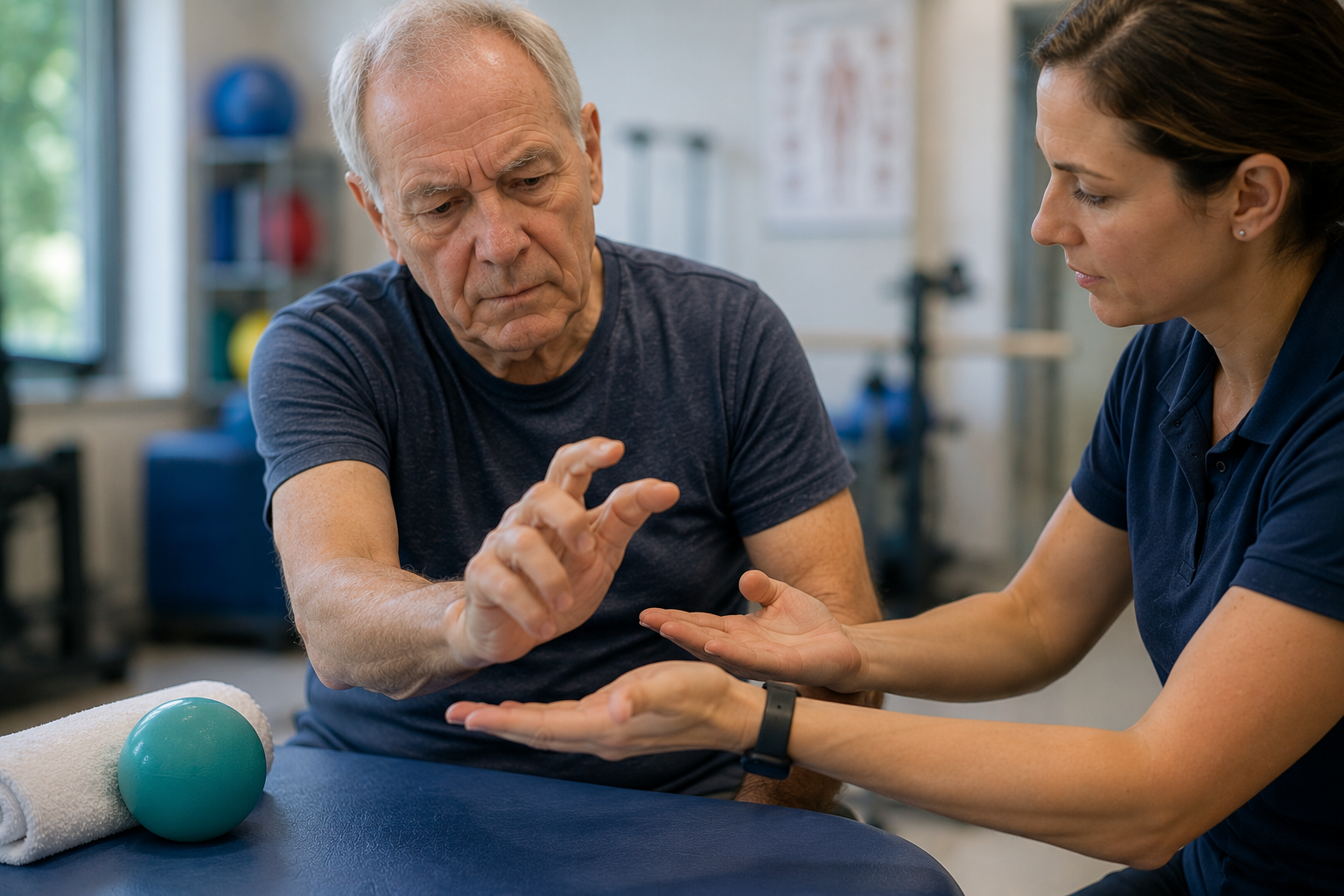
Why Your Hand Doesn't Open as Easily After a Stroke
After a stroke, many people notice a frustrating problem with their affected hand:
They can grip an object—but they have trouble letting it go.
Or they may feel as though their fingers are constantly curled, making it difficult to fully open the hand.
This can affect everyday activities such as:
- Releasing a cup
- Opening your hand to reach for an object
- Washing your palm
- Getting dressed
- Using utensils
- Letting go of a railing
- Placing an object on a table
Difficulty opening the hand after a stroke is common, but it isn’t always caused by simple weakness.
Several changes in the nervous system can affect how easily your fingers relax and extend.
Why Is Opening Your Hand So Difficult After a Stroke?
A stroke can disrupt communication between the brain and the muscles.
Your brain normally sends carefully coordinated signals that tell your muscles when to:
- Contract
- Relax
- Hold
- Release
After a stroke, those signals may be disrupted.
As a result, the muscles that close your hand may become overactive, while the muscles responsible for opening your fingers may be more difficult to activate.
This can make the hand feel stiff, tight, or “stuck.”
Stiffness and Increased Muscle Tone Can Play a Role
Some stroke survivors develop increased muscle tone, sometimes referred to as spasticity.
This can cause muscles to become overly active and resist movement.
In the hand, this may contribute to:
- Curled fingers
- A tightly closed fist
- Difficulty straightening the fingers
- Resistance when trying to open the hand
- Discomfort or tightness
The amount of stiffness can vary from person to person and may also change throughout the day.
Strength Isn’t the Same as Control
You may be able to grip something tightly.
But that doesn’t necessarily mean you have good control over opening your hand.
Hand function requires your brain to coordinate both sides of the movement:
Close → hold → release.
If releasing is difficult, even a strong grip can interfere with everyday activities.
For example, you may successfully pick up a cup but struggle to place it back on the table.
You may be able to hold onto a shirt but have trouble adjusting your grip.
That’s why hand rehabilitation needs to focus on more than simply strengthening the muscles.
Learn more: https://synapticrehab.com/why-fine-motor-skills-matter-more-than-grip-strength/
Difficulty Opening Your Hand Can Affect Daily Life
Your hands constantly need to alternate between gripping and releasing.
When releasing becomes difficult, everyday tasks may take longer and require more effort.
You may notice challenges with:
- Picking up and putting down objects
- Washing your hands
- Getting dressed
- Preparing food
- Using eating utensils
- Handling a phone
- Opening drawers and cabinets
- Participating in hobbies
These challenges can become frustrating because you may know exactly what you want your hand to do.
Your brain and hand just aren’t communicating as efficiently as they did before the stroke.
Why the Problem May Feel Worse Some Days
Many stroke survivors notice that stiffness changes.
One day, the hand may feel relatively loose.
Another day, the fingers may feel much tighter.
Several factors may influence how your body feels, including:
- Fatigue
- Stress
- Overall activity
- Illness
- Time of day
If you notice significant or sudden changes, discuss them with your healthcare provider.
Can Therapy Help?
Yes. Neurological rehabilitation can focus on improving how the hand is used during meaningful activities.
The appropriate treatment depends on your individual abilities and the specific reasons your hand is difficult to open.
How Occupational Therapy Can Help
Occupational therapy often plays a central role in helping stroke survivors improve functional hand use.
Treatment may include:
Practicing Hand Opening and Releasing
Therapy can focus on purposeful movements that require the hand to:
- Open
- Reach
- Grasp
- Hold
- Release
Practicing these movements during real activities can help connect therapy to everyday life.
Task-Specific Training
Rather than only exercising the hand, therapy may involve activities such as:
- Picking up objects
- Releasing objects into containers
- Using household items
- Grooming
- Dressing
The goal is to improve the skills you actually need throughout the day.
Addressing the Whole Arm
Hand function doesn’t happen in isolation.
Shoulder movement, elbow control, wrist position, and posture can all affect how well the hand works.
Therapy may address the entire arm to improve functional movement.
Preventing Secondary Problems
If the hand remains in a tightly closed position, it can become harder to maintain comfortable movement and hand hygiene.
A rehabilitation professional can provide individualized guidance based on your needs.
Don’t Force Your Hand Open
It can be tempting to repeatedly force your fingers straight.
But aggressive stretching or forcing a stiff hand can cause pain or injury.
The safest approach depends on why your hand is difficult to open and how much stiffness or muscle activity is present.
A qualified healthcare professional can evaluate the hand and recommend an appropriate rehabilitation plan.
Improvement Is About Function
The goal isn’t necessarily to make your hand look perfectly normal.
The goal is to improve your ability to use it during everyday life.
Progress might mean:
- Opening your hand a little more easily
- Releasing an object with less assistance
- Using the affected hand during more activities
- Keeping your hand comfortable
- Improving independence with daily tasks
Small improvements can make a meaningful difference.
When Should You Seek an Evaluation?
Consider an occupational or neurological rehabilitation evaluation if, after a stroke, you notice:
- Your fingers remain curled
- Your hand feels increasingly stiff
- You can grip objects but struggle to release them
- Your hand is difficult to clean or care for
- Everyday tasks are becoming more difficult
- You are avoiding using the affected hand
Identifying the cause of the problem is an important first step.
Difficulty opening the hand may involve weakness, changes in muscle tone, coordination problems, motor control, or a combination of factors.
Your Hand Can Be Strong and Still Need Rehabilitation
After a stroke, hand recovery isn’t simply about squeezing harder.
Your brain needs to coordinate reaching, opening, grasping, holding, and releasing.
When one part of that process becomes difficult, everyday activities can become more challenging.
The right neurological rehabilitation program can focus on the specific barriers affecting your hand function and help you work toward greater independence.
Schedule a Neurological Rehabilitation Evaluation
📍 Synaptic Rehabilitation
1200 Route 22 East, Suite 4
Bridgewater, NJ 08807
📞 Call: 908-801-6425
If you’re having difficulty opening your hand, releasing objects, or using your affected arm after a stroke, occupational and neurological therapy can help identify what’s limiting your movement and create a personalized plan to improve functional hand use and independence.
Learn more about how neurological rehabilitation can help you regain the skills that matter most in everyday life.

Steven Cheung, DPT
Steven is the founder and lead physical therapist at SYNAPTIC Rehabilitation. He earned a BS in Exercise Science Applied Kinesiology from Rutgers University in New Brunswick, NJ and his Doctorate degree from American International College in Springfield, MA. Steven specializes in movement disorders such as Parkinson’s disease and many other neurological disorders. Outside of practicing physical therapy Steven enjoys time with his wife, running, and staying active.