
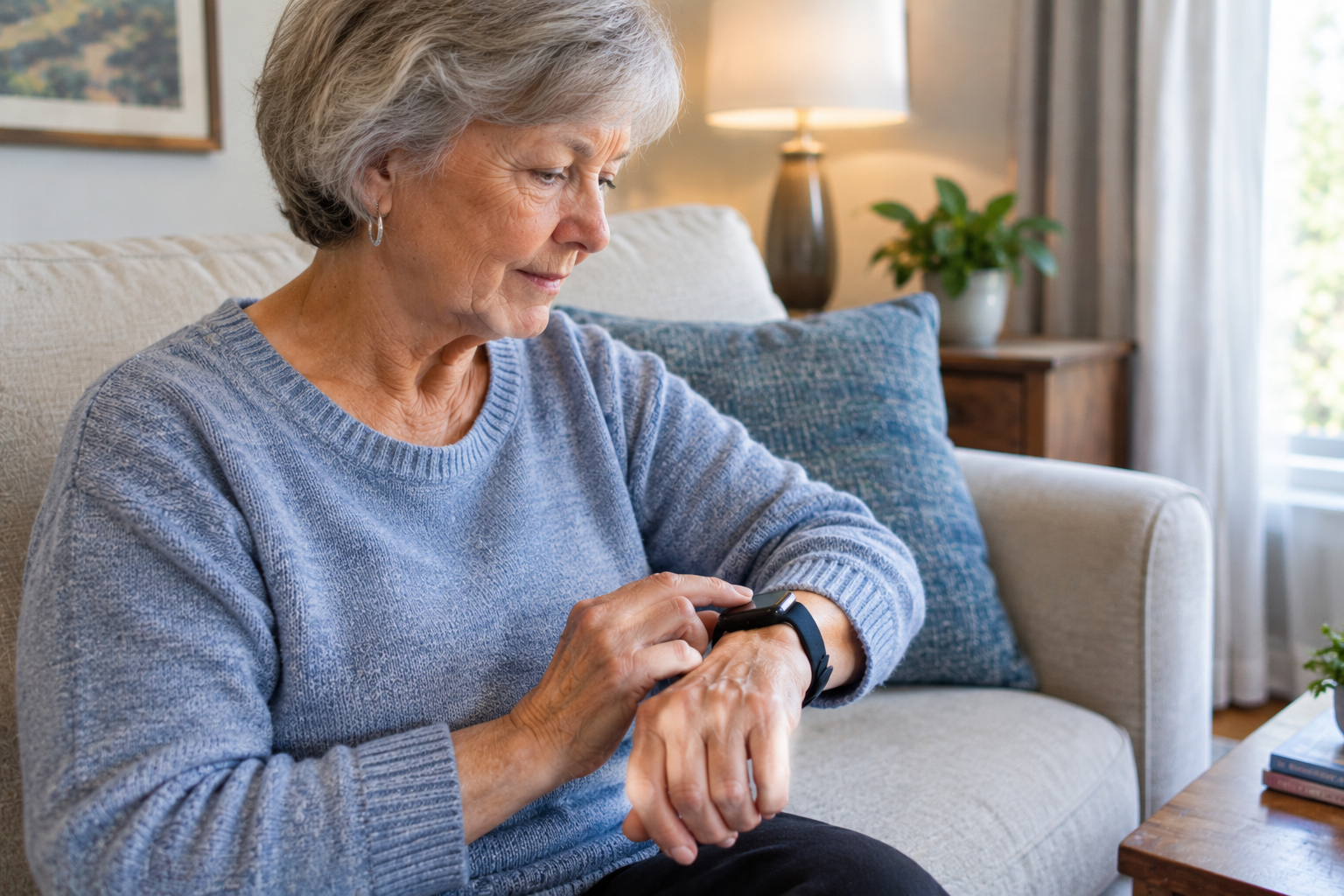
Can Your Smartwatch Detect Changes in Your Mobility? What Older Adults Should Know
Your smartwatch tells you how many steps you took today, how long you slept, and sometimes how quickly your heart beats. But could it also help you notice changes in the way you move?
For older adults, a smartwatch can be more than a way to count steps. It may help you recognize changes in daily activity, walking habits, or exercise consistency that are easy to overlook. For example, you might notice that you’re walking less than you did a few months ago, taking fewer trips outside, or struggling to reach your usual activity goal.
These changes don’t automatically mean you’re losing mobility. Busy schedules, illness, weather, pain, and fatigue can all affect your activity. Still, your smartwatch may offer useful information when you look at the bigger picture.
Here’s what wearable technology can tell you about your mobility, what it can’t tell you, and how physical therapy may help if everyday movement is becoming more difficult.
What Can a Smartwatch Tell You About Your Mobility?
Most smartwatches and fitness trackers collect information about movement and activity. Depending on the device, you may be able to review step counts, walking distance, exercise minutes, heart rate, and trends in your activity over time.
These measurements can help you understand your habits. The key is knowing what each one actually means.
1. You’re Taking Fewer Steps Than You Used To
Imagine that you usually take 5,000 to 6,000 steps a day. Over several weeks, your average drops to 3,000.
That change might have a simple explanation. Perhaps you spent more time indoors, had a busy week, or temporarily reduced your activity because you weren’t feeling well.
But if your step count stays lower and you also notice that you’re avoiding walks, using the stairs less often, or relying more on others for errands, it may be worth looking into.
A step counter can’t tell you why your activity has changed. It can, however, give you a starting point for a conversation about what feels different.
2. Your Walking Routine Is Becoming Less Consistent
You might notice that you no longer take your usual morning walk or that you need more breaks to finish it.
A smartwatch may help you spot changes in how often you walk or how much activity you complete in one session.
Pay attention to your experience, too. Are you getting tired sooner? Do you feel less steady when you turn around? Have you started choosing shorter routes because you’re worried about falling?
These details matter because mobility involves more than the number of steps you take. It also includes how comfortably, confidently, and safely you move.
3. Your Usual Activities Feel More Difficult
A smartwatch may show that you’re moving less, but it won’t necessarily capture the reason.
Perhaps you’re still walking around the house but have stopped going to the grocery store alone. Maybe you can walk for ten minutes on a flat surface but feel unsteady when navigating curbs or uneven sidewalks.
These everyday changes can be more meaningful than a single activity score.
If a task that used to feel routine now takes more effort, consider what has changed. Are you experiencing pain, weakness, fatigue, shortness of breath, or difficulty with balance? Sharing these observations with a healthcare professional can help determine what needs attention.
Can a Smartwatch Detect Balance Problems or an Increased Risk of Falling?
Some wearable devices offer walking-related measurements or features designed to identify possible changes in gait. Certain devices may also provide fall-detection features.
However, a smartwatch cannot reliably rule out a balance problem or tell you whether you’re safe from falling.
Balance depends on several systems working together, including vision, sensation, muscle strength, coordination, and the body’s ability to respond to changes in position. A watch doesn’t fully measure how these systems work together during everyday activities.
You might have a normal step count but still struggle when turning, stepping over an obstacle, walking in a crowded space, or carrying something while moving.
Similarly, someone who uses a cane or walker may find that a wrist-worn device doesn’t accurately count every step. Wearable measurements can be less reliable for people who walk slowly or use mobility aids.
That’s why smartwatch data should be treated as one piece of information, not a diagnosis or a substitute for a professional mobility assessment.
Four Changes Worth Paying Attention To
Your daily activity data may be most useful when you combine it with what you notice in real life.
Consider discussing these changes with your healthcare provider or physical therapist if they persist or affect your daily routine:
- You’re walking less without an obvious reason. Your usual errands or neighborhood walks have become less frequent.
- You need more breaks. Activities that once felt manageable now leave you unusually tired.
- You’re becoming less confident on your feet. You avoid stairs, uneven ground, or busy places because you feel unsteady.
- You’re relying on support more often. You increasingly reach for furniture, hold someone’s arm, or depend on a railing to move around.
None of these changes automatically points to a specific condition. They are simply reasons to take a closer look, particularly if they are new, persistent, or getting worse.
If you experience sudden difficulty walking, sudden weakness, new numbness, or other possible stroke symptoms, call 911 rather than waiting to review your activity data.
How to Use Your Smartwatch Without Becoming Focused on the Numbers
Fitness trackers can be helpful, but it’s easy to become overly concerned with daily targets. A lower step count doesn’t necessarily mean you’ve lost progress, and reaching a daily goal doesn’t guarantee that your mobility is improving.
Try using your smartwatch as a tool for noticing patterns rather than judging your performance.
Look at trends, not just one day
Compare your activity over several weeks instead of reacting to a single low-activity day. Look for changes that persist and consider whether illness, weather, travel, or other circumstances might explain them.
Pay attention to how you feel
Ask yourself a few simple questions:
- Am I walking as comfortably as I did a few months ago?
- Do I feel steady when I turn or change direction?
- Can I still do my usual errands and household activities?
- Am I avoiding activities because they feel difficult or unsafe?
Your answers can provide context that your device can’t capture.
Set goals that fit your abilities
Your activity goals should reflect your health, current fitness, and any physical limitations. You don’t need to hit an arbitrary step count to benefit from movement.
The CDC’s guidance on physical activity for older adults recommends a combination of aerobic activity, muscle-strengthening activities, and balance activities for adults ages 65 and older. The right starting point will vary from person to person.
If you have a history of falls, significant balance difficulties, or a medical condition that affects movement, talk with your healthcare provider before making major changes to your exercise routine.
How Physical Therapy Can Help You Understand Changes in Mobility
Your smartwatch may help you notice that something has changed. A physical therapist can help assess how you’re moving and explore what may be contributing to the difficulty.
A physical therapy assessment may look at several areas, including:
Walking and gait: How you walk, change direction, navigate obstacles, and move across different surfaces.
Balance and coordination: How well you maintain stability when standing, reaching, turning, or changing positions.
Strength and endurance: Whether muscle weakness or reduced stamina is making everyday activities harder.
Functional mobility: How comfortably you get up from a chair, climb stairs, move around your home, and manage daily tasks.
The findings help guide an individualized plan based on your goals and abilities. Depending on your needs, treatment may include targeted exercises, balance training, walking practice, and strategies for moving more safely during everyday activities.
For people living with neurological conditions such as Parkinson’s disease or recovering from a stroke, a therapist can also assess movement challenges that may not be obvious from step counts alone.
You can learn more about physical therapy at Synaptic Rehabilitation’s Bridgewater clinic and our approach to helping people improve mobility and function.
We also discuss the role of technology in rehabilitation in our article, Unlocking the Potential of In-Home Physical Therapy.
The Bottom Line: Your Smartwatch Is a Tool, Not a Mobility Test
A smartwatch can help you track activity and notice patterns over time. If your steps are decreasing or your usual walking routine is changing, that information may be useful.
But the numbers don’t tell the whole story. They can’t fully assess your balance, explain why movement has become harder, or determine whether you’re at risk of falling.
What matters most is how you’re functioning in daily life. If walking, standing, turning, or completing familiar activities has become more difficult, don’t rely on your device to decide whether something needs attention.
A physical therapist can help assess your mobility, identify areas that may benefit from treatment, and develop a plan that fits your needs.
Concerned About Changes in Your Mobility?
At Synaptic Rehabilitation, we help adults work toward safer movement, improved function, and greater independence through individualized physical and occupational therapy.
If you’ve noticed changes in your walking, balance, or ability to manage everyday activities, our team can help you explore your options.
Synaptic Rehabilitation
1200 Route 22 East, Suite 4
Bridgewater, NJ 08807
Call 908-801-6425 to learn more about our therapy services.

Steven Cheung, DPT
Steven is the founder and lead physical therapist at SYNAPTIC Rehabilitation. He earned a BS in Exercise Science Applied Kinesiology from Rutgers University in New Brunswick, NJ and his Doctorate degree from American International College in Springfield, MA. Steven specializes in movement disorders such as Parkinson’s disease and many other neurological disorders. Outside of practicing physical therapy Steven enjoys time with his wife, running, and staying active.