
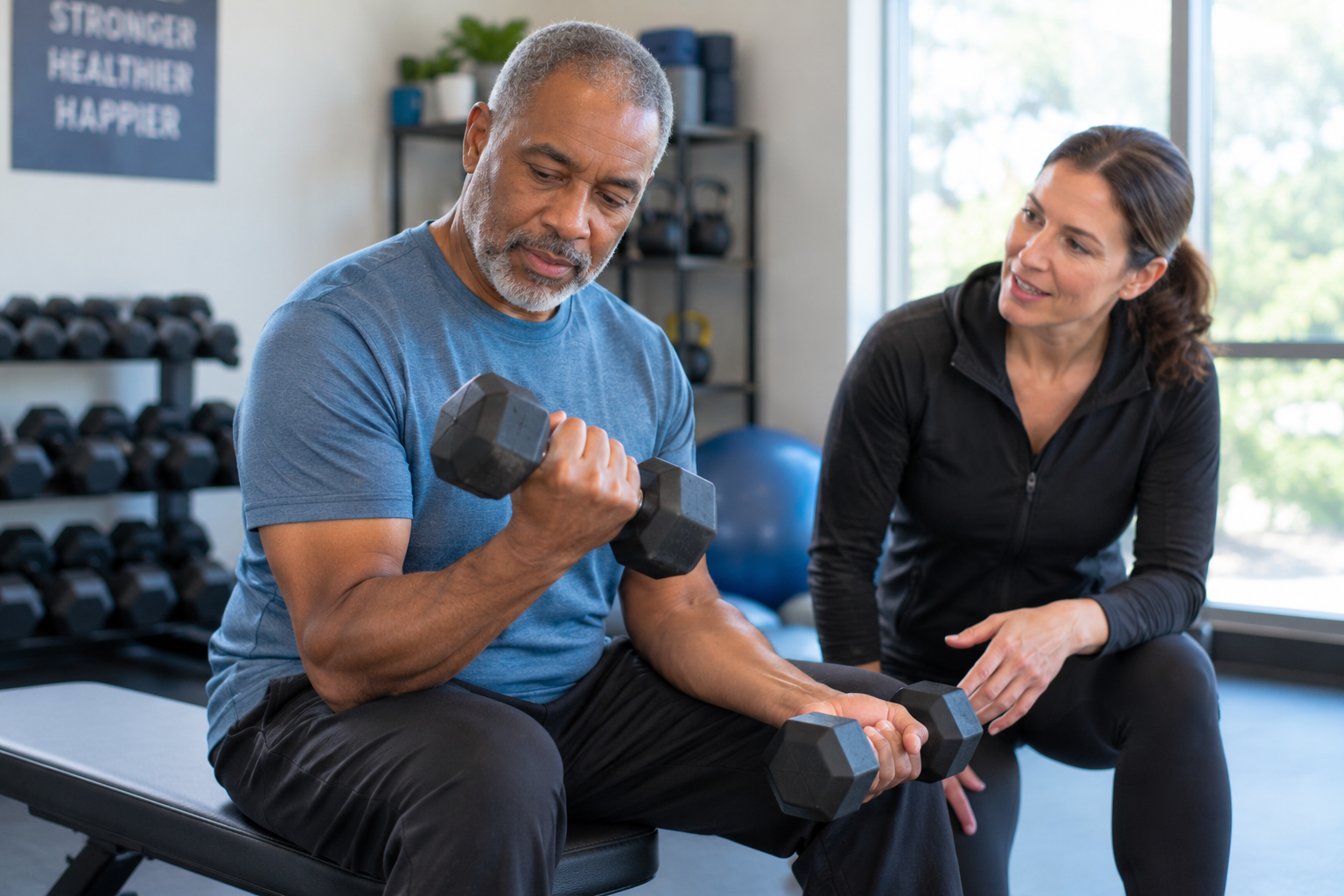
Strength Training After 50: Why Being Stronger Doesn't Always Mean Moving Better
You can lift weights, exercise regularly, and still find certain everyday movements surprisingly difficult.
Maybe you have no trouble carrying grocery bags but struggle to get up from a low couch. You can complete a workout but feel unsteady when stepping off a curb. Or your legs feel strong, yet climbing stairs takes more effort than it used to.
These experiences highlight an important distinction: being strong and being able to use that strength during everyday activities aren’t exactly the same thing.
As we get older, maintaining muscle strength is important. But everyday mobility also depends on balance, coordination, endurance, flexibility, and the ability to adjust your movements to different situations.
Understanding how these pieces work together can help you make your exercise routine more useful for daily life.
Why Strength Alone Doesn’t Tell the Whole Story
Muscle strength helps you produce force. Functional movement requires you to use that force at the right time, in the right direction, and with enough control to complete a task safely.
Consider getting out of a chair. You need leg strength to push upward, but you also need to shift your weight forward, coordinate your hips and knees, and maintain your balance as you stand.
If any part of that sequence is difficult, the movement may feel harder than you’d expect.
Here are four other factors that can affect how well you move.
1. Balance Helps You Use Your Strength Safely
You may have enough leg strength to step onto a curb, but if you’re uncertain about your balance, you might hesitate or reach for something to hold.
Balance allows you to control your body while standing, walking, turning, and changing direction. It also helps you respond when you encounter an unexpected obstacle or lose your footing slightly.
Strengthening exercises can support balance, but they don’t automatically train every balance skill you need.
2. Coordination Helps Your Body Work as a Team
Everyday movements often require several body parts to work together.
Climbing stairs involves coordinating your legs, shifting your weight, and adjusting your posture. Walking through a crowded store requires you to change direction, avoid obstacles, and respond to people moving around you.
If your coordination is affected, you may feel awkward or less confident even when you have reasonable muscle strength.
Practicing movements that resemble your daily activities can help address this gap.
3. Endurance Helps You Keep Going
Can you perform a movement once but struggle to repeat it throughout the day?
That may be a sign that endurance matters as much as peak strength.
For example, standing up from a chair once may feel manageable, but getting up repeatedly while cooking, doing laundry, and moving around the house can be tiring.
Building endurance gradually can help you sustain activity. The appropriate amount depends on your health, current fitness, and any symptoms you experience during exercise.
4. Mobility and Flexibility Help You Reach the Positions You Need
Your joints need enough comfortable movement to complete everyday tasks.
Limited ankle movement, for instance, can affect how you step forward or navigate stairs. Restricted hip movement may make getting dressed or rising from a low seat more difficult.
Strength training doesn’t always address these limitations by itself. Your exercise plan may also need mobility work or specific movement practice.
What Is Functional Strength Training?
Functional strength training focuses on building strength that supports real-world activities.
Rather than measuring progress only by how much weight you lift, it also considers how comfortably and confidently you perform movements you use throughout the day.
Depending on your abilities, functional exercises might include:
- Sit-to-stand practice: Building strength and control for getting up from a chair.
- Step-ups: Practicing the movement patterns used when climbing stairs, with suitable support and supervision when needed.
- Supported weight shifts: Learning to move your weight from one leg to the other while maintaining stability.
- Carrying exercises: Practicing how to carry appropriate objects while maintaining posture and control.
- Walking and turning practice: Working on the movements needed to navigate your home and community.
These exercises aren’t suitable for everyone in the same form. Someone who feels steady and active may be able to perform more challenging variations, while someone with a history of falls may need a therapist to modify the activity and provide support.
The best exercise program reflects your current abilities and the tasks you want to make easier.
How to Tell Whether Your Exercise Routine Is Helping
Progress doesn’t always show up as heavier weights or more repetitions.
You may notice improvements in the way you handle everyday activities instead.
Look for changes such as:
- Getting up from a chair with less effort.
- Climbing stairs with greater control.
- Walking farther before feeling tired.
- Turning around without feeling as unsteady.
- Carrying everyday items while maintaining your balance.
- Feeling more confident when moving around your home or neighborhood.
These are practical signs that your exercise routine may be helping you use your strength more effectively.
You don’t need to test yourself with difficult tasks to see whether you’re improving. Simply pay attention to the activities you already do and whether they feel easier over time.
If an activity causes pain, dizziness, unusual shortness of breath, or significant instability, stop and seek appropriate medical guidance.
How Much Exercise Do Adults Over 50 Need?
There isn’t one exercise routine that works for every person over 50. Your needs depend on your health, current activity level, goals, and any conditions that affect your movement.
The CDC’s physical activity guidelines for adults recommend that adults aim for at least 150 minutes of moderate-intensity aerobic activity each week, along with muscle-strengthening activity on at least two days, as their abilities and health allow.
Older adults also benefit from activities that address balance.
These recommendations are general targets, not a requirement to start at full intensity. If you’ve been inactive, have a chronic health condition, or experience difficulty with balance or walking, you may need to begin with shorter sessions and progress gradually.
Consistency matters more than trying to do too much at once.
When Might Physical Therapy Help?
If you’re exercising regularly but still struggling with everyday movement, it may be useful to look beyond strength alone.
A physical therapist can assess how your strength, balance, coordination, joint mobility, and endurance work together during functional activities.
For example, if getting out of a chair is difficult, the issue might involve leg weakness, limited joint movement, balance concerns, or difficulty coordinating the movement. Different causes may call for different strategies.
A physical therapy program may include:
Targeted strengthening: Exercises that address specific muscle groups involved in your daily activities.
Balance training: Practice designed to improve stability during standing, stepping, and changing direction.
Functional movement practice: Rehearsing everyday tasks such as rising from a chair, climbing stairs, or reaching safely.
Walking and endurance training: Building the ability to move comfortably for longer periods, when appropriate.
Individualized exercise guidance: Learning how to progress your activity safely and adapt exercises to your needs.
For people recovering from a stroke or living with Parkinson’s disease or another neurological condition, strength may be only one part of the picture. Changes in coordination, movement speed, sensation, or motor planning can also affect everyday function.
In these situations, therapy can focus on the specific challenges that make daily activities difficult.
You Don’t Have to Choose Between Strength and Better Movement
Strength training is valuable at every age, and maintaining muscle strength can support independence as you get older.
But the goal isn’t simply to become stronger in the gym. It’s also to use that strength when you stand up, climb stairs, walk outdoors, carry groceries, and take part in the activities that matter to you.
If you’re strong enough to complete an exercise but still struggle with the movement you need in daily life, your routine may need to address more than muscle strength alone.
A more complete approach considers how you move, how you maintain your balance, and how comfortably you can repeat everyday tasks.
Want to Move With Greater Confidence?
At Synaptic Rehabilitation, we help adults work toward improved mobility, strength, balance, and independence through individualized physical and occupational therapy.
If everyday activities are becoming harder despite your efforts to stay active, our team can help you explore what may be contributing to the difficulty and which therapy options may be appropriate for you.
Synaptic Rehabilitation
1200 Route 22 East, Suite 4
Bridgewater, NJ 08807
Call 908-801-6425 to learn more about our therapy services.

Steven Cheung, DPT
Steven is the founder and lead physical therapist at SYNAPTIC Rehabilitation. He earned a BS in Exercise Science Applied Kinesiology from Rutgers University in New Brunswick, NJ and his Doctorate degree from American International College in Springfield, MA. Steven specializes in movement disorders such as Parkinson’s disease and many other neurological disorders. Outside of practicing physical therapy Steven enjoys time with his wife, running, and staying active.