
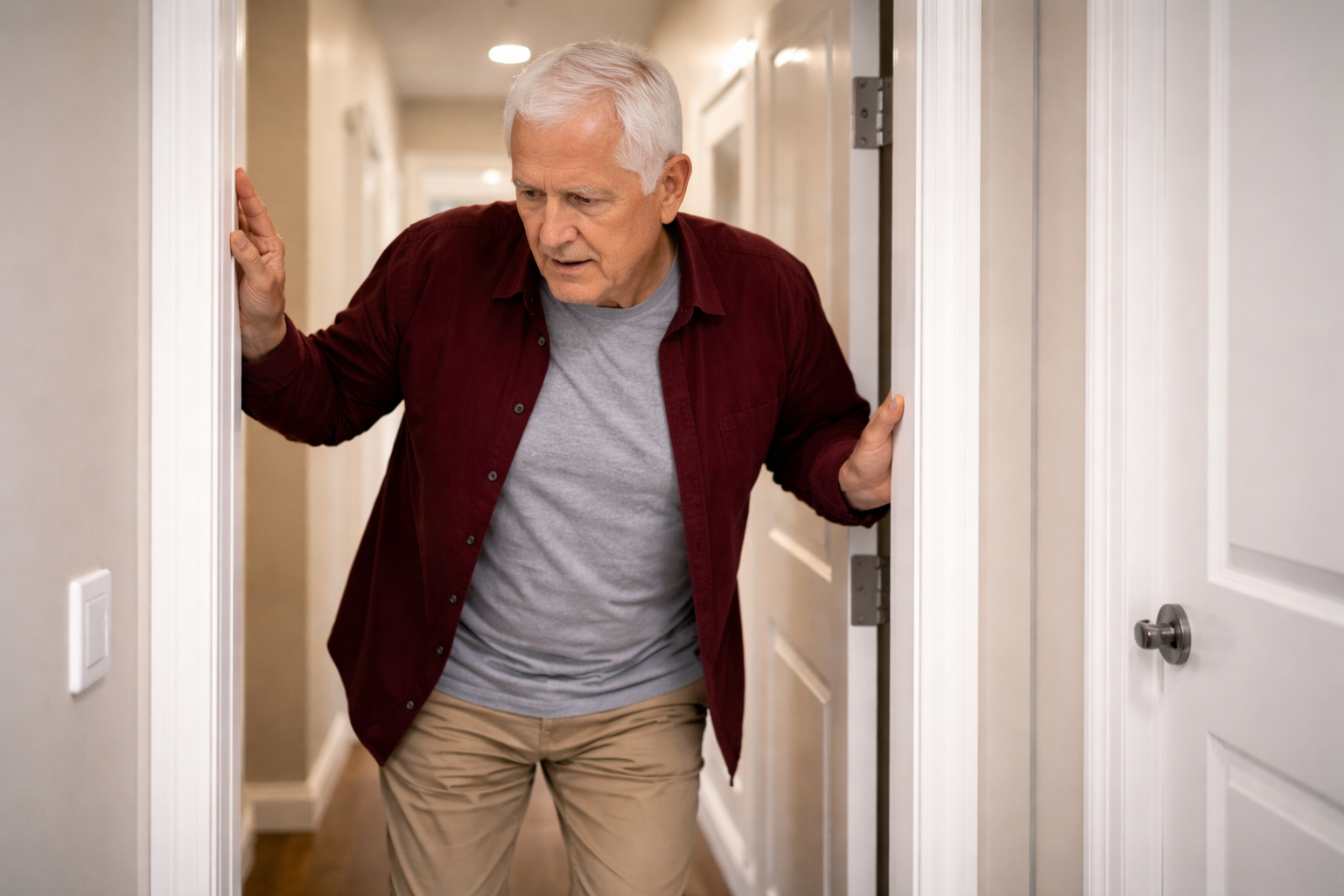
Why Doorways and Narrow Spaces Increase Fall Risk
Most people don’t think twice about walking through a doorway.
But for many older adults — and especially individuals with Parkinson’s disease — doorways and narrow spaces are some of the most common places where balance breaks down.
If you’ve ever felt hesitant stepping through a doorway or turning in a tight hallway, there’s a reason.
These environments place unique demands on your balance, coordination, and spatial awareness.
Why Narrow Spaces Are More Difficult to Navigate
Walking through open space is predictable.
Doorways and tight areas require your brain to:
- Judge distance and width accurately
- Adjust step size and direction
- Coordinate turning and forward movement
- Maintain balance in a confined space
Even small errors in timing or positioning can lead to instability.
The Brain Slows You Down in Tight Spaces
When approaching a narrow space, your brain becomes more cautious.
You may notice:
- Slower steps
- Hesitation before entering
- Shortened stride
- A feeling of “pausing” or uncertainty
This hesitation is your brain trying to prevent a collision or loss of balance — but it can actually disrupt your normal walking rhythm.
Why Doorways Are a Known Trigger for Instability
1. Visual Compression
Doorways reduce your visual field, making it harder to judge space and movement.
This can disrupt your sense of direction and timing.
External source:
https://www.nia.nih.gov/health/balance-problems-and-falls
2. Forced Direction Changes
You often need to adjust your body position slightly to pass through a doorway, especially if turning or carrying something.
Internal link:
[Why Turning Is Harder Than Walking Straight — and How Physical Therapy Helps](internal link to published blog)
3. Reduced Margin for Error
In open spaces, small missteps are manageable. In narrow areas, there’s less room to recover.
4. Divided Attention
Doorways often involve multitasking:
- Carrying objects
- Talking
- Turning into another room
Internal link:
[Why Walking and Talking at the Same Time Can Increase Fall Risk](internal link to published blog)
Doorways and Parkinson’s Disease
Doorways are one of the most common triggers for freezing of gait in Parkinson’s disease.
Individuals may experience:
- Sudden inability to step forward
- Shuffling at the threshold
- Hesitation or “sticking” in place
External source:
https://www.parkinson.org/understanding-parkinsons/movement-symptoms/freezing
Internal link:
[Freezing of Gait in Parkinson’s: Why It Happens More Often in Winter](internal link to published blog)
This happens because narrow spaces increase the demand on movement planning and coordination.
Common Real-Life Situations Where Risk Increases
- Walking through doorways at home
- Entering bathrooms or small rooms
- Navigating tight hallways
- Turning into a room while talking
- Carrying items through narrow spaces
These everyday movements are often overlooked — but they’re high-risk moments.
How Physical Therapy Improves Safety in Tight Spaces
1. Gait and Movement Retraining
Therapists help restore smooth, continuous walking patterns — even in confined spaces.
Internal link:
How Physical Therapy Helps Improve Gait and Balance as You Age
2. Turning and Transition Training
Practicing controlled turns and direction changes reduces hesitation and instability.
3. Parkinson’s-Specific Cueing Strategies
For individuals with Parkinson’s, therapists use visual and rhythmic cues to help initiate movement through doorways.
Internal link:
Parkinson’s Disease Treatment Programs
4. Real-World Scenario Training
Therapy often includes simulated environments to safely practice navigating tight spaces.
When to Pay Attention
Consider a balance evaluation if:
- You hesitate at doorways
- You feel “stuck” entering rooms
- You take multiple small steps to pass through narrow spaces
- You’ve had near-falls in tight areas
These are early warning signs — not something to ignore.
Small Spaces Shouldn’t Feel Unsafe
Doorways are part of everyday life. You shouldn’t have to think twice about walking through them.
With the right training, these movements can become smooth, automatic, and safe again.
Schedule a Balance & Mobility Evaluation
📍 Synaptic Rehabilitation
1200 Route 22 East, Suite 4
Bridgewater, NJ 08807
📞 Call: 908-801-6425
If tight spaces or doorways are starting to feel challenging, physical therapy can help you move with confidence again.

Steven Cheung, DPT
Steven is the founder and lead physical therapist at SYNAPTIC Rehabilitation. He earned a BS in Exercise Science Applied Kinesiology from Rutgers University in New Brunswick, NJ and his Doctorate degree from American International College in Springfield, MA. Steven specializes in movement disorders such as Parkinson’s disease and many other neurological disorders. Outside of practicing physical therapy Steven enjoys time with his wife, running, and staying active.