
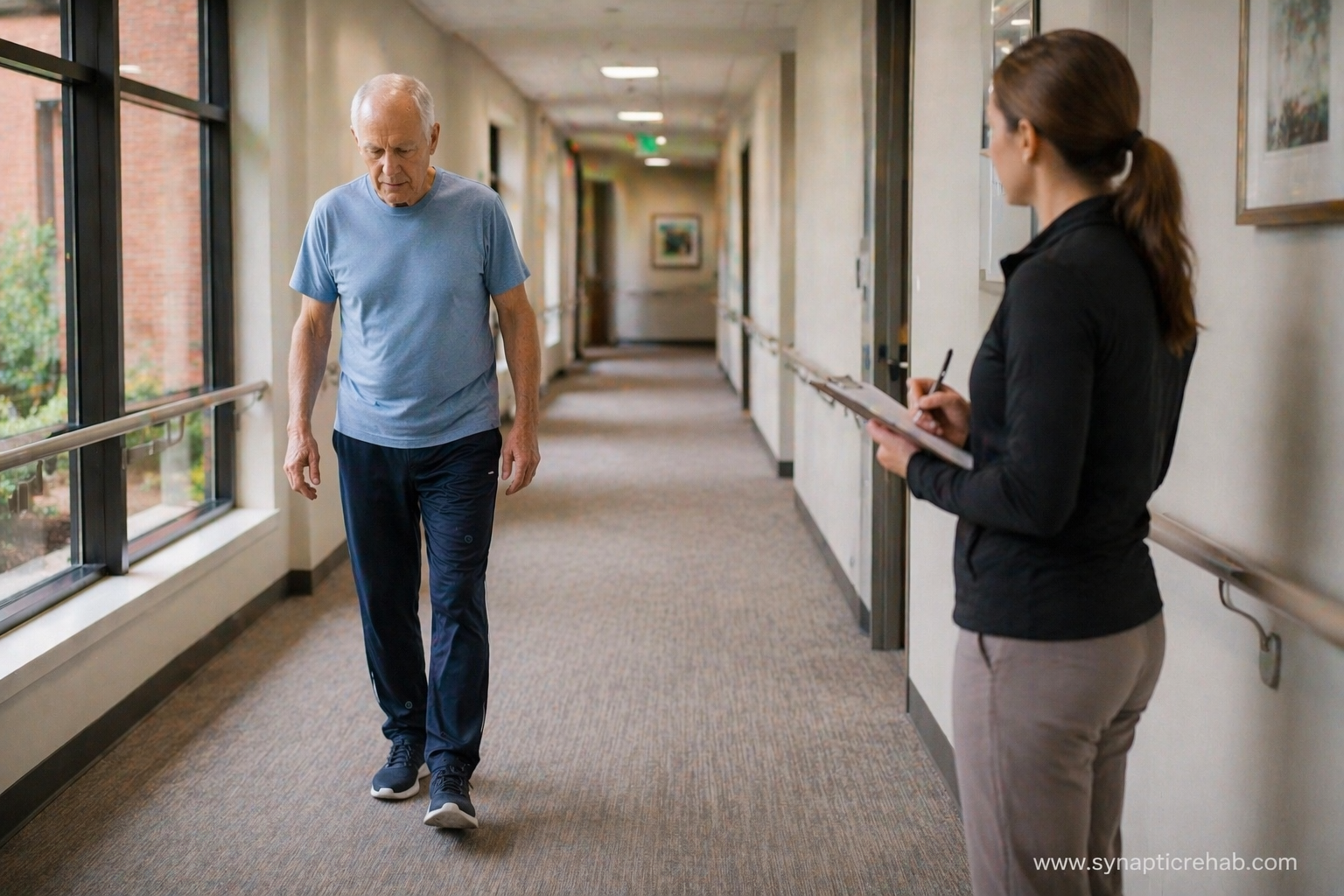
Why Your Walking Pattern Changes When You’re Being Watched
Have you ever noticed your walking feels different when someone is watching you?
Maybe you walk a little stiffer.
Take more careful steps.
Or suddenly feel less natural.
This is more common than people realize — and it can actually affect your balance, coordination, and fall risk.
Walking Is Normally Automatic
Under normal conditions, walking is controlled automatically by your brain.
You don’t think about:
- Step length
- Arm swing
- Timing
- Posture
It just happens.
But when you become aware of your walking — especially when being observed — that automatic system can get disrupted.
What Happens When You Start “Thinking” About Walking
When you focus on your walking, your brain shifts control from automatic movement to conscious control.
This can lead to:
- Stiffer movements
- Shorter steps
- Reduced arm swing
- Slower walking speed
- Less natural rhythm
This is similar to what happens in dual-task situations.
https://synapticrehab.com/why-walking-and-talking-at-the-same-time-can-increase-fall-risk/
Why Self-Conscious Walking Can Affect Balance
Walking works best when it’s smooth and rhythmic.
Overthinking movement can:
- Interrupt timing
- Reduce coordination
- Increase muscle tension
- Make balance corrections less efficient
https://synapticrehab.com/the-hidden-role-of-arm-swing-in-safe-walking/
Instead of moving naturally, your body becomes more rigid — which actually makes balance harder.
The “Performance Effect” on Movement
This is sometimes called a performance effect — when being observed changes how you move.
You might:
- Try to “walk better”
- Overcorrect your posture
- Slow yourself down too much
- Focus too hard on each step
Ironically, trying to walk perfectly often makes walking less stable.
Why This Matters More With Age
As we age:
- Movement becomes less automatic
- Reaction time slows
- Balance requires more attention
That means any added mental focus — like being watched — can interfere with walking.
https://synapticrehab.com/how-physical-therapy-can-help-improve-gait-and-balance-as-you-age/
Parkinson’s Disease and Movement Awareness
For individuals with Parkinson’s disease, this effect can be even more noticeable.
Parkinson’s affects the brain’s ability to automate movement. As a result:
- Walking requires more conscious effort
- External pressure can increase hesitation
- Freezing episodes may become more likely
- Movement may feel less fluid
https://synapticrehab.com/services/parkinsons-disease-treatment/
External source:
https://www.parkinson.org/understanding-parkinsons/movement-symptoms
Common Situations Where This Happens
- Walking in a clinic or medical setting
- Being observed by family members
- Walking in crowded public spaces
- Navigating unfamiliar environments
https://synapticrehab.com/why-your-balance-feels-worse-in-busy-environments/
In all of these situations, awareness increases — and natural movement decreases.
Signs This May Be Affecting You
- You feel more stiff when someone is watching
- Your walking feels less natural in public
- You slow down when observed
- You feel more stable when alone
These are subtle signs your movement system is becoming more conscious than automatic.
How Physical Therapy Helps Restore Natural Movement
1. Gait Retraining
Helps restore smooth, automatic walking patterns.
https://synapticrehab.com/parkinsons-disease-physical-therapy-in-bridgewater-nj/
2. Dual-Task Training
Improves your ability to move naturally even when attention is divided.
https://synapticrehab.com/why-walking-and-talking-at-the-same-time-can-increase-fall-risk/
3. Confidence Building
Reduces fear and self-consciousness around movement.
https://synapticrehab.com/how-physical-therapy-helps-you-regain-confidence-after-a-near-fall/
4. Parkinson’s-Specific Strategies
Uses cueing and rhythm techniques to restore automatic movement.
https://synapticrehab.com/services/parkinsons-disease-treatment/
Walking Should Feel Natural — Not Forced
If your walking changes when you’re being watched, it’s not just in your head.
It’s a sign your movement system is relying more on conscious control than automatic function.
The goal of physical therapy is to restore that natural rhythm — so walking feels effortless again, no matter the situation.
Schedule a Gait & Balance Evaluation
📍 Synaptic Rehabilitation
1200 Route 22 East, Suite 4
Bridgewater, NJ 08807
📞 Call: 908-801-6425
If walking feels different when you’re being observed, physical therapy can help you regain natural movement, confidence, and stability in any environment.

Steven Cheung, DPT
Steven is the founder and lead physical therapist at SYNAPTIC Rehabilitation. He earned a BS in Exercise Science Applied Kinesiology from Rutgers University in New Brunswick, NJ and his Doctorate degree from American International College in Springfield, MA. Steven specializes in movement disorders such as Parkinson’s disease and many other neurological disorders. Outside of practicing physical therapy Steven enjoys time with his wife, running, and staying active.