
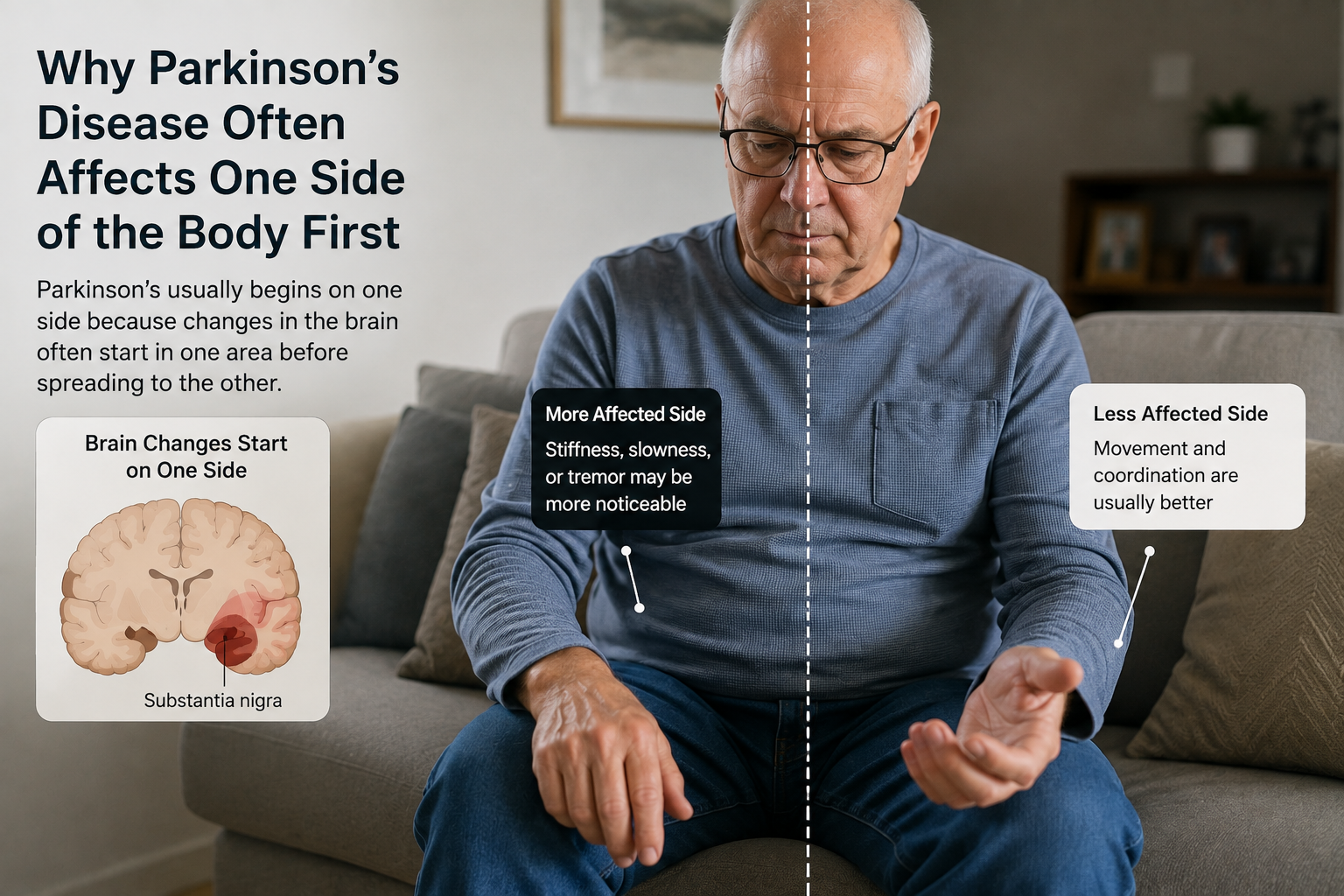
Why Parkinson's Disease Often Affects One Side of the Body First
One of the things that can make early Parkinson’s disease confusing is that symptoms often don’t begin evenly throughout the body.
You may first notice changes on just one side.
For example:
- One hand develops a tremor.
- One arm stops swinging as much while walking.
- One leg feels stiffer.
- One side of the body feels slower.
- One hand becomes less coordinated during everyday activities.
Over time, symptoms may affect both sides of the body. But Parkinson’s disease often begins with symptoms that are noticeably worse on one side.
Why does this happen?
It has to do with how Parkinson’s disease affects the brain.
Parkinson’s Disease Often Begins Asymmetrically
Parkinson’s disease affects cells in the brain that produce dopamine, a chemical involved in controlling movement.
The loss of these cells does not always happen at exactly the same rate on both sides of the brain.
Because each side of the brain is largely connected with movement on the opposite side of the body, uneven changes in the brain can contribute to symptoms appearing more noticeably on one side.
This is why someone may first notice:
- A tremor in one hand
- Reduced arm swing on one side
- Stiffness in one arm or leg
- Slower movement on one side
As the condition progresses, symptoms may eventually become more noticeable on both sides.
One-Sided Symptoms Can Be an Early Clue
Parkinson’s disease doesn’t always begin with a dramatic tremor.
Sometimes the first signs are subtle.
A spouse or family member may notice that one arm:
- Doesn’t swing normally while walking
- Stays closer to the body
- Moves less during conversation
The person themselves may notice that one side feels:
- Stiffer
- Slower
- Less coordinated
These changes can develop gradually and may initially be mistaken for normal aging, arthritis, or an old injury.
Why One Arm May Move Less While Walking
Arm swing is a natural part of normal walking.
When one arm begins swinging less, it can be an early movement change associated with Parkinson’s disease.
Reduced arm swing may occur because of:
- Stiffness
- Reduced movement amplitude
- Slower automatic movement
- Changes in coordination
Because these changes can happen gradually, family members may notice them before the person with Parkinson’s does.
Learn more: https://synapticrehab.com/why-parkinsons-disease-makes-everyday-movements-feel-smaller/
It’s Not Just About Tremors
Tremor is one of the symptoms people most often associate with Parkinson’s disease.
However, not everyone with Parkinson’s begins with a noticeable tremor.
Other movement changes can include:
- Stiffness
- Slowness
- Smaller movements
- Reduced arm swing
- Changes in walking
- Difficulty with fine motor tasks
This is one reason Parkinson’s disease can be difficult to recognize in its earliest stages.
One Side May Feel Less Coordinated
Someone with Parkinson’s may notice that one hand becomes more difficult to use during everyday activities.
For example, you might have trouble with:
- Buttoning clothing
- Typing
- Writing
- Handling coins
- Using utensils
These problems aren’t always caused by weakness.
Parkinson’s disease can affect the size, speed, and coordination of movement.
Learn more: https://synapticrehab.com/why-fine-motor-skills-matter-more-than-grip-strength/
Can Parkinson’s Symptoms Stay on One Side?
Parkinson’s symptoms can remain more pronounced on one side for a long time.
However, Parkinson’s disease is a progressive neurological condition, and symptoms can eventually affect both sides of the body.
Even when both sides are affected, one side may continue to be more affected than the other.
Every person’s experience with Parkinson’s is different.
Why Early Movement Changes Matter
Subtle changes can affect everyday life before a person realizes how much their movement has changed.
For example, reduced movement on one side may contribute to:
- Difficulty reaching
- Less natural walking
- Changes in posture
- Challenges with dressing
- Reduced hand dexterity
Recognizing these changes early allows individuals to discuss them with their medical team and consider appropriate rehabilitation strategies.
How Physical Therapy Can Help
Physical therapy for Parkinson’s disease focuses on maintaining mobility, movement quality, balance, and confidence.
Treatment may include:
Larger, More Intentional Movements
Because Parkinson’s can cause movements to become smaller, therapy may emphasize making movements larger and more purposeful.
Walking and Gait Training
Treatment may address:
- Step length
- Walking speed
- Turning
- Arm movement
- Posture
The goal is to help maintain efficient and confident movement.
Balance Training
Changes in movement and posture can affect balance over time.
Targeted exercises can challenge balance in a safe environment and prepare you for everyday activities.
How Occupational Therapy Can Help
Occupational therapy can address the everyday tasks affected by changes on one side of the body.
This may include:
- Dressing
- Handwriting
- Fine motor activities
- Cooking
- Grooming
- Using technology
The goal is to help you continue participating in the activities that matter to you.
Learn more: https://synapticrehab.com/what-does-occupational-therapy-actually-help-with/
One-Sided Symptoms Shouldn’t Be Ignored
If you notice new or gradually worsening symptoms on one side of your body, it’s important not to diagnose yourself.
Tremor, stiffness, and changes in movement can have different causes.
A healthcare professional can evaluate your symptoms and determine whether further testing or treatment is appropriate.
Parkinson’s Rehabilitation Is About Staying Active and Independent
Living with Parkinson’s disease doesn’t mean giving up the activities you enjoy.
Rehabilitation can focus on maintaining the skills you need for everyday life.
This may include:
- Walking confidently
- Moving with larger movements
- Maintaining balance
- Using your hands effectively
- Staying active in the community
A personalized rehabilitation program can address your specific symptoms and goals.
Schedule a Parkinson’s Rehabilitation Evaluation
📍 Synaptic Rehabilitation
1200 Route 22 East, Suite 4
Bridgewater, NJ 08807
📞 Call: 908-801-6425
If Parkinson’s disease is causing stiffness, slower movement, reduced arm swing, or changes that are more noticeable on one side of your body, neurological physical and occupational therapy can help you maintain mobility, function, and independence.
Learn more about Parkinson’s rehabilitation and how therapy can help you keep moving with confidence.

Steven Cheung, DPT
Steven is the founder and lead physical therapist at SYNAPTIC Rehabilitation. He earned a BS in Exercise Science Applied Kinesiology from Rutgers University in New Brunswick, NJ and his Doctorate degree from American International College in Springfield, MA. Steven specializes in movement disorders such as Parkinson’s disease and many other neurological disorders. Outside of practicing physical therapy Steven enjoys time with his wife, running, and staying active.