
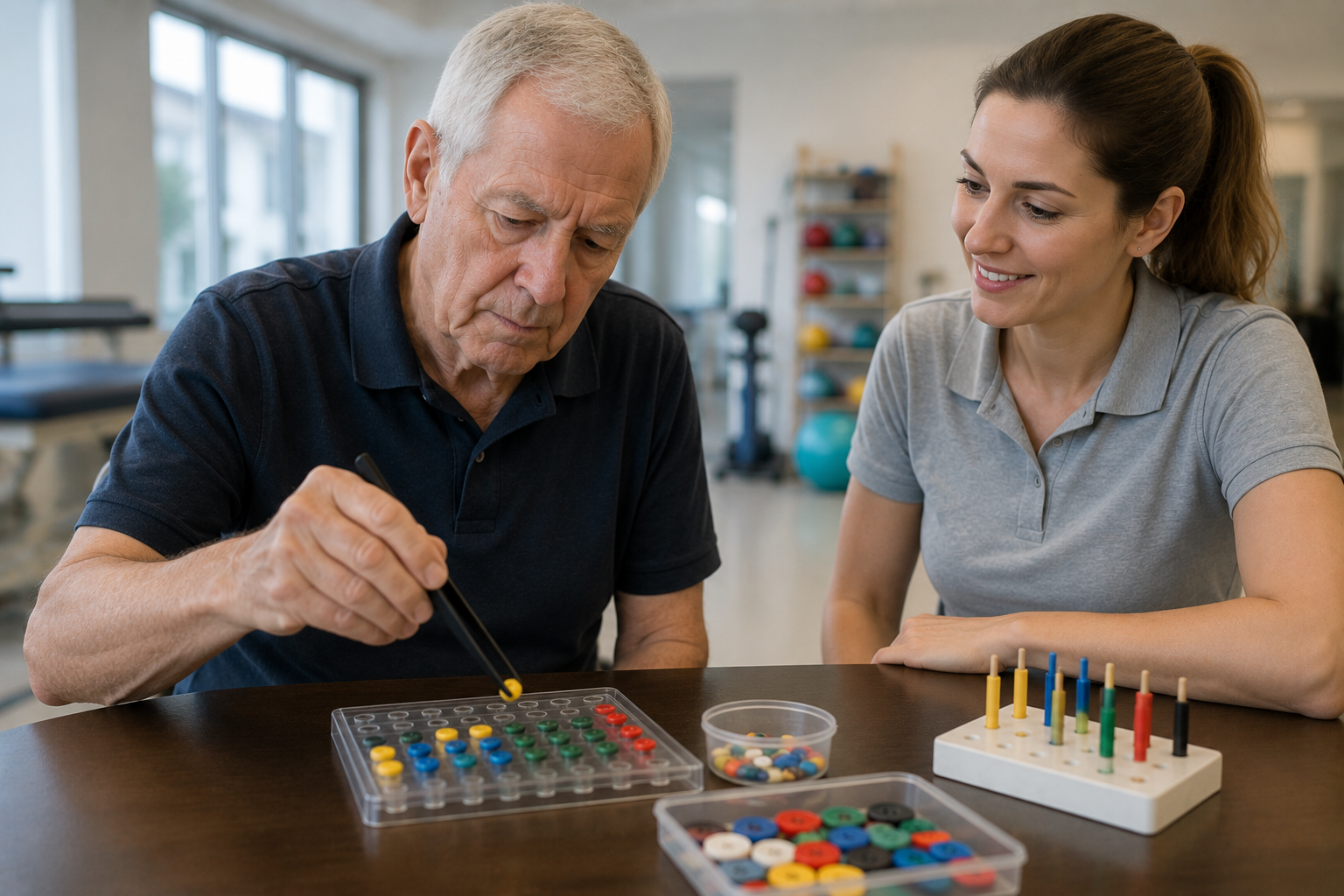
Why Fine Motor Skills Matter More Than Grip Strength
When people think about hand function, they often think about grip strength.
Can you squeeze someone’s hand firmly?
Can you hold onto a grocery bag?
Can you lift a gallon of milk?
While strength is important, it isn’t the whole picture.
In fact, many people recovering from a stroke or living with Parkinson’s disease have enough strength to hold an object—but still struggle with the small, precise movements needed for everyday life.
That’s because fine motor skills are often more important than raw strength.
What Are Fine Motor Skills?
Fine motor skills are the small, controlled movements you make with your hands and fingers.
They allow you to perform everyday tasks such as:
- Buttoning a shirt
- Picking up coins
- Holding a pen
- Typing on a keyboard
- Using a smartphone
- Turning a key in a lock
- Opening medication bottles
- Zipping a jacket
These movements require coordination, timing, sensation, and precision—not just strong muscles.
Strength Doesn’t Equal Function
Imagine being able to squeeze a stress ball with ease but struggling to pick up a dime from a table.
Or being able to carry a shopping bag but having difficulty fastening a necklace.
These situations are common after neurological injuries because the brain controls much more than muscle strength.
Successful hand function depends on:
- Finger coordination
- Grip control
- Timing
- Sensation
- Wrist stability
- Motor planning
If even one of these systems is affected, everyday tasks can become frustrating.
Learn more: https://synapticrehab.com/why-your-hand-feels-strong-but-still-doesnt-work-properly-after-a-stroke/
Why Fine Motor Skills Change After a Stroke
A stroke can interrupt the communication between the brain and the muscles of the hand.
As a result, you may notice:
- Difficulty picking up small objects
- Slower finger movements
- Trouble releasing items
- Reduced coordination
- Hand fatigue during detailed tasks
Even if strength improves, fine motor control often requires additional rehabilitation.
External source:
https://www.stroke.org/en/about-stroke/effects-of-stroke/physical-effects-of-stroke
Parkinson’s Disease Can Affect Hand Dexterity Too
Parkinson’s disease often causes movements to become smaller and slower.
This can make tasks like:
- Writing
- Buttoning clothing
- Using utensils
- Handling coins
- Typing
feel more difficult than they once did.
Many people assume these changes are caused by weakness, but they’re usually related to movement control and coordination.
Learn more: https://synapticrehab.com/why-parkinsons-disease-makes-everyday-movements-feel-smaller/
Everyday Tasks That Depend on Fine Motor Skills
You probably use fine motor skills hundreds of times each day without thinking about it.
Examples include:
- Brushing your teeth
- Applying makeup or shaving
- Cooking
- Sorting mail
- Paying bills
- Using a TV remote
- Tying your shoes
- Picking up a credit card from a countertop
When these tasks become difficult, they can affect your confidence and independence.
Why Occupational Therapy Focuses on Dexterity
Occupational therapists help people improve the skills needed for everyday living.
Treatment often focuses on:
- Finger coordination
- Hand-eye coordination
- Object manipulation
- Grip control
- Functional hand use
Rather than simply strengthening the hand, therapy emphasizes using it more effectively during real-world activities.
Learn more: https://synapticrehab.com/what-does-occupational-therapy-actually-help-with/
How Physical Therapy Supports Hand Function
Although occupational therapy often leads hand rehabilitation, physical therapy can also play an important role—especially for people with neurological conditions.
Physical therapists help improve:
- Posture
- Shoulder stability
- Arm movement
- Coordination
- Overall mobility
These improvements provide a stable foundation for better hand function during daily activities.
Signs Your Fine Motor Skills May Need Attention
You may benefit from an evaluation if you notice:
- Frequently dropping objects
- Difficulty fastening buttons or zippers
- Slower handwriting
- Trouble using eating utensils
- Difficulty opening containers
- Increased frustration with small tasks
These challenges are common, but they don’t have to become your new normal.
Better Hand Function Starts With Better Coordination
Strength is only one piece of the puzzle.
The ability to perform everyday tasks depends on how well your brain, muscles, and senses work together.
Improving fine motor skills can make dressing, cooking, writing, and other daily activities feel easier and more natural.
With the right rehabilitation program, many people can improve both hand function and independence.
Schedule a Neurological Rehabilitation Evaluation
📍 Synaptic Rehabilitation
1200 Route 22 East, Suite 4
Bridgewater, NJ 08807
📞 Call: 908-801-6425
If you’re having difficulty with buttons, handwriting, cooking, or other everyday hand tasks, our physical and occupational therapy team can help improve your coordination, dexterity, and confidence so you can stay as independent as possible.

Steven Cheung, DPT
Steven is the founder and lead physical therapist at SYNAPTIC Rehabilitation. He earned a BS in Exercise Science Applied Kinesiology from Rutgers University in New Brunswick, NJ and his Doctorate degree from American International College in Springfield, MA. Steven specializes in movement disorders such as Parkinson’s disease and many other neurological disorders. Outside of practicing physical therapy Steven enjoys time with his wife, running, and staying active.