
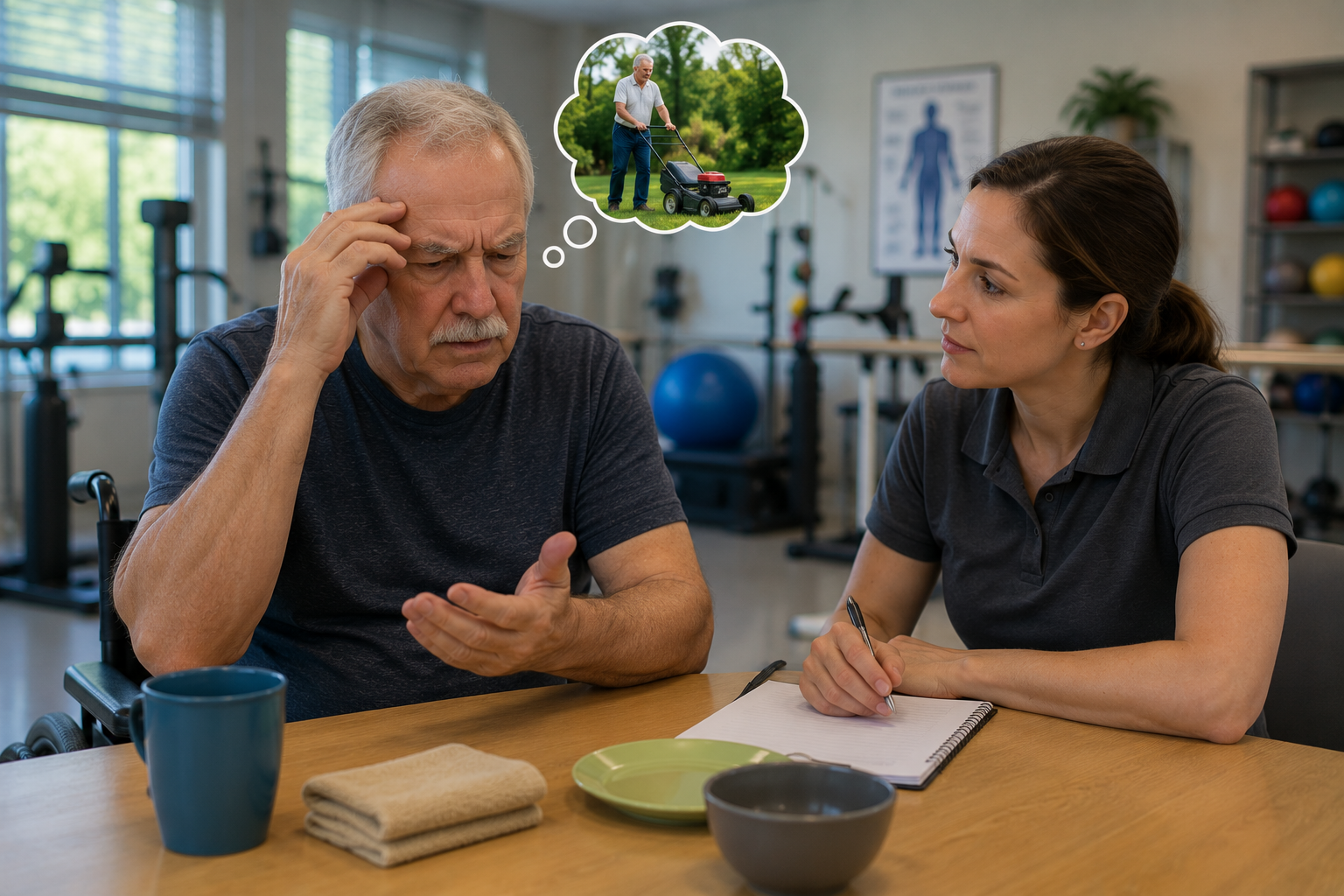
Why You Know What You Want to Do After a Stroke but Can't Figure Out How to Do It
Imagine asking someone to brush their teeth.
They know exactly what you mean. They understand what a toothbrush is, where it is, and what they’re supposed to do with it.
But when they try, something doesn’t work.
They may hold the toothbrush incorrectly, struggle to sequence the movements, or appear unsure how to begin.
This can be confusing for the person experiencing it—and for their family.
The problem may not be weakness.
It may be apraxia, a neurological condition that can occur after a stroke.
What Is Apraxia?
Apraxia is a difficulty performing learned, purposeful movements even though the person may have enough strength and understands what they are being asked to do.
In simple terms, the brain knows the goal but has trouble organizing the movements needed to accomplish it.
Someone with apraxia may understand:
“Put on your shirt.”
But the process of figuring out how to position the shirt, find the armholes, and move through the sequence can become difficult.
This isn’t the same thing as simply forgetting how to dress.
The brain is having trouble planning and organizing the movement.
Apraxia Isn’t the Same as Weakness
This distinction is important.
A person recovering from a stroke may have weakness that makes movement physically difficult.
Apraxia is different.
Someone may have relatively good strength but still struggle to perform a familiar task correctly.
For example, they may be able to:
- Move their arm
- Grip an object
- Raise their hand
- Walk
But have difficulty using those abilities together to complete a specific task.
That’s why simply doing more strengthening exercises may not address the underlying problem.
What Does Apraxia Look Like in Everyday Life?
Apraxia can become noticeable during activities that require a sequence of purposeful movements.
Examples include:
- Brushing teeth
- Using eating utensils
- Getting dressed
- Using a comb
- Making a cup of coffee
- Opening and using household items
- Using tools
- Following familiar routines
A person may appear to know what they want to accomplish but become stuck when trying to perform the steps.
Why Family Members Sometimes Misunderstand It
Apraxia can be frustrating because it doesn’t always look like a physical disability.
A family member might think:
“You know how to do this. Why aren’t you doing it?”
But the person isn’t necessarily refusing, forgetting, or not trying.
Their brain may be having difficulty translating the intended action into the correct sequence of movements.
Understanding this distinction can make rehabilitation much less frustrating for everyone involved.
Apraxia Can Affect More Than the Hands
Although apraxia is often noticeable during hand and arm activities, it can affect other purposeful movements as well.
A person may have difficulty:
- Using objects correctly
- Following movement demonstrations
- Performing gestures
- Completing multi-step activities
- Coordinating movements during daily routines
The specific difficulties depend on the area and severity of the neurological injury.
Why Familiar Tasks Can Suddenly Become Difficult
Before a stroke, many daily activities are essentially automatic.
You don’t consciously think through every step of brushing your teeth or putting on a shirt.
After a stroke, the brain may have difficulty accessing or organizing those learned movement patterns.
This can make a familiar activity feel completely unfamiliar.
The person may need to slow down and consciously work through each part of the task.
How Occupational Therapy Can Help
This is where occupational therapy can play an important role.
Occupational therapists focus on helping people regain the ability to perform meaningful daily activities.
Treatment may involve:
Breaking Tasks Into Smaller Steps
Instead of completing an entire activity at once, the therapist may divide it into manageable components.
For example:
- Pick up the toothbrush.
- Apply toothpaste.
- Position the toothbrush.
- Bring it to the mouth.
- Begin brushing.
Breaking down the sequence can make the task easier to understand and practice.
Repeated Practice
The brain benefits from repetition.
Practicing meaningful tasks repeatedly gives the nervous system opportunities to reinforce movement patterns and develop more effective strategies.
The goal isn’t simply to perform an exercise.
It’s to improve the ability to complete a real-life activity.
Using Visual and Verbal Cues
Therapists may use demonstrations, verbal instructions, visual cues, or other strategies to help a person organize movement.
The appropriate strategy depends on the individual’s specific challenges.
Practicing Functional Activities
Instead of focusing exclusively on isolated movements, therapy can incorporate activities such as:
- Dressing
- Grooming
- Eating
- Meal preparation
- Household tasks
- Hobbies
This helps connect rehabilitation directly to the person’s daily life.
What Can Family Members Do?
If someone you love is experiencing apraxia after a stroke, patience is important.
Try to avoid immediately taking over the task.
Instead:
- Give the person extra time.
- Break complicated tasks into smaller steps.
- Use simple, clear instructions.
- Demonstrate the movement when appropriate.
- Avoid rushing.
- Celebrate successful attempts.
The goal is to provide enough support to promote independence without doing everything for them.
Apraxia Doesn’t Mean Recovery Is Impossible
Neurological recovery isn’t always straightforward.
A person may have good strength but still struggle with functional movement because the brain is having difficulty organizing the action.
That doesn’t mean therapy has nothing to offer.
With individualized neurological rehabilitation, people can learn strategies for completing challenging activities and, in some cases, improve their ability to perform the movements themselves.
The focus should be on what the person can do, what is limiting them, and what strategies can help them become more independent.
When Should You Seek an Evaluation?
Consider a neurological rehabilitation evaluation if you or someone you love has difficulty performing familiar tasks after a stroke despite having enough strength to attempt them.
Pay particular attention if you notice:
- Difficulty sequencing everyday activities
- Trouble using familiar objects
- Difficulty following movement demonstrations
- Repeatedly performing steps out of order
- Frustration with tasks that used to be automatic
An evaluation can help determine whether the problem is related to strength, coordination, motor planning, cognition, sensation, or another neurological factor.
Schedule a Neurological Rehabilitation Evaluation
📍 Synaptic Rehabilitation
1200 Route 22 East, Suite 4
Bridgewater, NJ 08807
📞 Call: 908-801-6425
If a stroke has made familiar everyday activities unexpectedly difficult, neurological and occupational therapy can help identify what’s getting in the way and develop strategies to improve function, confidence, and independence.
Learn more about neurological rehabilitation and how therapy can help you regain the skills that matter most in everyday life.

Steven Cheung, DPT
Steven is the founder and lead physical therapist at SYNAPTIC Rehabilitation. He earned a BS in Exercise Science Applied Kinesiology from Rutgers University in New Brunswick, NJ and his Doctorate degree from American International College in Springfield, MA. Steven specializes in movement disorders such as Parkinson’s disease and many other neurological disorders. Outside of practicing physical therapy Steven enjoys time with his wife, running, and staying active.