
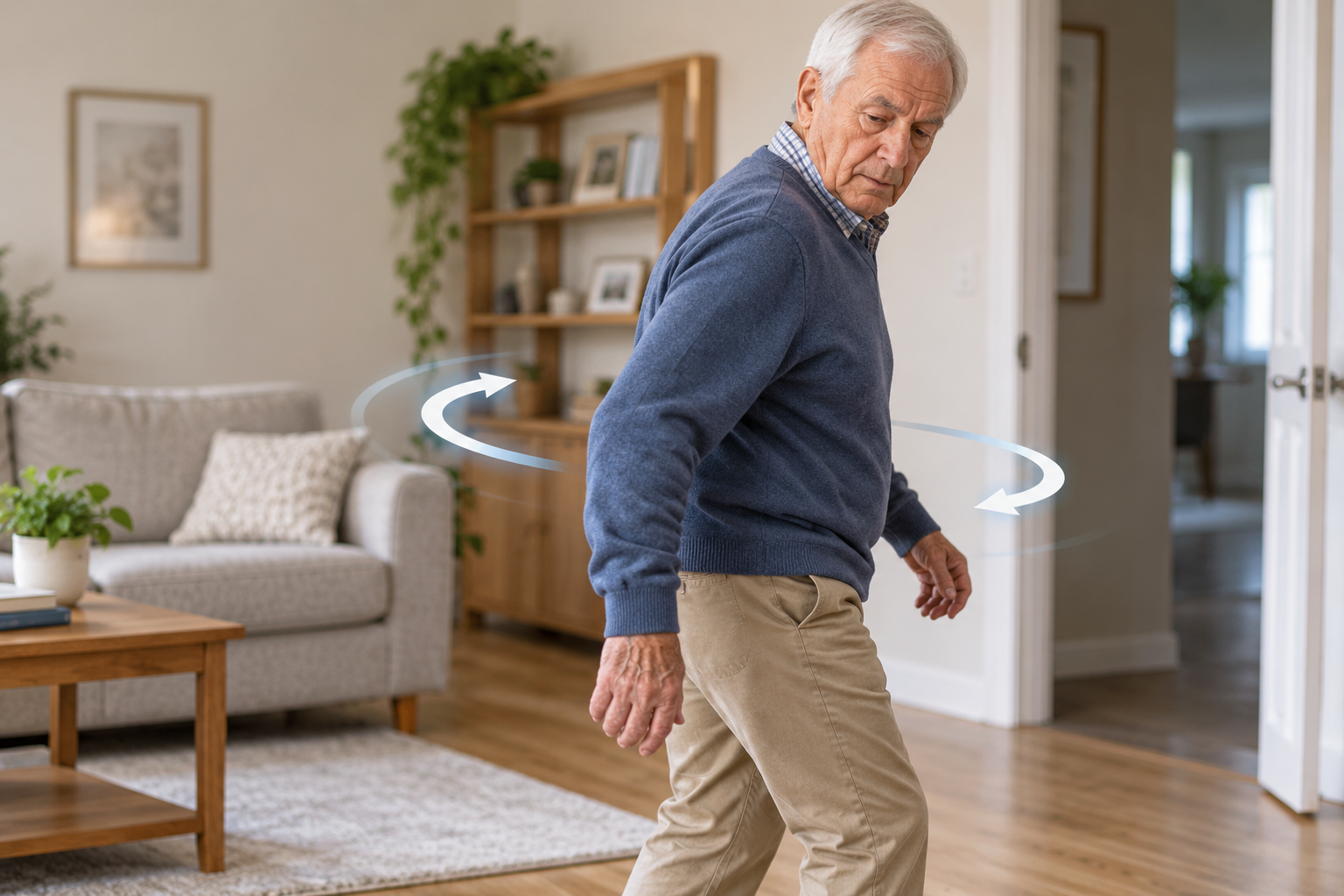
Why Parkinson’s Can Make Turning Around More Difficult
Turning around seems simple.
You walk toward the kitchen, realize you need to go back, and change direction.
But for someone with Parkinson’s disease, turning can be one of the more challenging parts of walking.
You may notice that you take several small steps to turn, feel unsteady when changing direction, or have trouble getting your feet to move when you want to turn.
For some people, turning can also be associated with freezing of gait, when the feet temporarily feel as though they’re stuck to the floor.
Understanding why turning becomes difficult can help you approach it more safely.
Why Is Turning Harder With Parkinson’s?
Walking in a straight line is relatively predictable.
Turning requires your body to do several things at once.
You need to:
- Shift your weight
- Change the direction of your body
- Adjust your foot placement
- Coordinate both legs
- Maintain your balance
- Control the speed of the movement
- Know where you’re going next
Parkinson’s disease can affect the automatic control of movement. As a result, movements that once happened without much thought may require more conscious attention.
Turning is a good example.
You May Start Taking Smaller Steps
One thing you may notice is that your steps become shorter as you turn.
Instead of taking a larger step around a corner, you may take several small steps.
This can be especially noticeable when turning in tight spaces.
Small steps aren’t automatically dangerous, but they can make it harder to maintain a smooth, controlled turn.
If your feet begin moving faster than your body, you may also feel less stable.
Tight Spaces Can Make Turning Harder
Think about the places where you turn most often at home.
You might turn:
- Around the kitchen counter
- In a bathroom
- Beside your bed
- In a hallway
- When getting into a chair
- When walking through a doorway
These areas don’t always give you much room to make a wide turn.
When space is limited, you may try to turn more quickly or use several small steps.
That’s why practicing turning in realistic environments can be useful during physical therapy.
Turning and Freezing of Gait
Some people with Parkinson’s experience freezing of gait.
During a freezing episode, you may feel as though your feet won’t move even though you want to keep walking.
Freezing can happen during certain situations, including:
- Turning
- Going through doorways
- Starting to walk
- Approaching a destination
- Moving through crowded spaces
Not everyone with Parkinson’s experiences freezing, and freezing can vary from person to person.
If it happens frequently or is affecting your safety, it’s important to discuss it with your healthcare team.
Why Turning Can Increase Fall Risk
Changing direction requires you to shift your weight while maintaining control of your body.
If that process becomes less coordinated, you may feel unsteady.
The risk can become greater when you’re:
- Turning quickly
- Carrying something
- Walking in a crowded area
- Distracted by conversation
- Moving in low lighting
- Trying to reach a destination quickly
That’s why learning how to turn with greater control can be an important part of fall prevention.
You May Need to Think About Something That Used to Be Automatic
One of the frustrating parts of Parkinson’s disease is that you may know exactly what you want your body to do, but the movement doesn’t happen as automatically as it once did.
Instead of simply thinking, “Turn left,” you may benefit from breaking the movement into more deliberate steps.
Physical therapy can help you develop movement strategies that make turning more predictable.
These strategies vary from person to person and should be practiced with a therapist who understands your specific movement challenges.
How Physical Therapy Can Help
A physical therapist can evaluate how you walk, turn, start moving, stop, and change directions.
Treatment may include practicing:
- Direction changes
- Weight shifting
- Step length
- Balance
- Turning in both directions
- Getting in and out of chairs
- Walking through doorways
- Navigating different environments
Your therapist may also introduce external cues or other movement strategies when appropriate.
The goal isn’t simply to practice turning in a therapy room.
It’s to help you use safer movement strategies during the situations you encounter at home and in the community.
Give Yourself More Time
One of the simplest strategies is also one of the most important:
Don’t rush your turns.
If you know that turning quickly makes you feel unstable, give yourself enough space and time to change direction.
Try not to combine a quick turn with another demanding task, such as carrying a heavy object or looking away from where you’re walking.
And if you feel your feet starting to freeze, don’t panic. Stop, regain your balance, and use the movement strategy you’ve practiced with your therapist.
Turning Is Part of Everyday Independence
Walking isn’t just about moving forward.
You turn when you get out of bed, enter a bathroom, sit in a chair, walk around your home, shop at a store, and move through a crowded room.
That’s why turning deserves attention when you’re working on mobility with Parkinson’s disease.
Improving how you approach turns may help you feel more confident navigating the spaces you encounter every day.
When Should You Talk With Your Therapist?
If turning has recently become more difficult, you’re taking increasingly small steps, or you feel unsteady when changing direction, bring it up with your rehabilitation team.
And if you’ve started experiencing freezing episodes or falls, make sure your healthcare provider knows.
Changes in walking and balance deserve attention, particularly when they’re affecting your ability to move safely.
Schedule a Neurological Rehabilitation Evaluation
📍 Synaptic Rehabilitation
1200 Route 22 East, Suite 4
Bridgewater, NJ 08807
📞 Call: 908-801-6425
If turning, freezing, or changes in walking are making everyday movement more difficult with Parkinson’s disease, contact Synaptic Rehabilitation to learn how physical therapy can help you work on safer, more controlled mobility.

Steven Cheung, DPT
Steven is the founder and lead physical therapist at SYNAPTIC Rehabilitation. He earned a BS in Exercise Science Applied Kinesiology from Rutgers University in New Brunswick, NJ and his Doctorate degree from American International College in Springfield, MA. Steven specializes in movement disorders such as Parkinson’s disease and many other neurological disorders. Outside of practicing physical therapy Steven enjoys time with his wife, running, and staying active.