
Why You Keep Missing Things on One Side After a Stroke
Have you ever noticed someone recovering from a stroke repeatedly missing things on one side?
Maybe they:
- Leave food on one side of their plate.
- Bump into doorframes.
- Miss objects sitting on a countertop.
- Forget to put one arm through a sleeve.
- Leave part of a room unexplored.
- Seem unaware of people standing on one side of them.
It can be easy to assume the problem is poor eyesight.
Sometimes it is.
But in some stroke survivors, the issue is something different: spatial neglect.
Spatial neglect is a neurological problem that can affect a person’s awareness of one side of their surroundings or even their own body.
And because it can interfere with everyday activities, recognizing it is important.
What Is Spatial Neglect?
Spatial neglect, sometimes called unilateral neglect, occurs when a person has difficulty responding to or being aware of information on one side of their environment or body following a brain injury.
The person isn’t necessarily choosing to ignore that side.
Their brain may not be adequately directing attention toward information coming from that side.
This can make the problem especially confusing for both the stroke survivor and their family.
It’s More Than Simply Not Seeing Something
One of the most important things to understand is that spatial neglect isn’t necessarily a problem with the eyes themselves.
A person may be able to see something but fail to appropriately notice or respond to it.
For example, imagine placing a cup on a table.
Someone with spatial neglect may look toward the table but fail to notice the cup on the affected side.
The issue involves attention and awareness, not simply whether the eyes can detect the object.
What Does Spatial Neglect Look Like at Home?
The signs can be subtle.
You might notice that a person:
Leaves Food on One Side of the Plate
They may finish eating the food they notice while leaving food untouched on the opposite side.
Bumps Into Objects
They may repeatedly hit:
- Doorways
- Furniture
- Countertops
- People
- Objects on the floor
Has Difficulty Getting Dressed
They may put clothing on only one side of the body or forget about an affected arm or leg.
Misses Things on a Counter
They might search for an item but repeatedly overlook it even though it is sitting nearby.
Groom Only One Side
They may brush their hair, shave, or perform other grooming tasks on only one side.
These behaviors aren’t necessarily intentional.
They can be signs that the brain isn’t adequately attending to one side.
Why Spatial Neglect Can Affect Safety
Failing to notice one side of the environment can create significant challenges during everyday activities.
For example, someone may not notice:
- A step
- A chair
- A doorway
- A vehicle
- A person walking nearby
- An object on the floor
This can increase the risk of collisions, trips, and falls.
It can also make activities such as cooking, bathing, dressing, and navigating the home more difficult.
Spatial Neglect vs. Vision Loss
These conditions can look similar, but they’re not necessarily the same.
A visual field loss occurs when part of the visual field is missing because of damage somewhere along the visual pathway.
Spatial neglect, on the other hand, involves reduced attention or awareness toward one side.
A person can have one, the other, or both.
That’s why a proper neurological evaluation is important rather than assuming that every problem with one side is simply an eyesight issue.
Why Occupational Therapy Can Be Helpful
Occupational therapists are trained to evaluate how neurological changes affect everyday activities.
Treatment can focus on helping a person become more aware of the affected side and safely incorporate it into daily routines.
Depending on the individual’s needs, therapy may include:
- Visual scanning strategies
- Structured reaching activities
- Dressing practice
- Grooming tasks
- Meal-related activities
- Environmental modifications
- Repeated practice during functional activities
The goal is to connect rehabilitation to the situations the person actually encounters at home and in the community.
Practicing Scanning Can Help
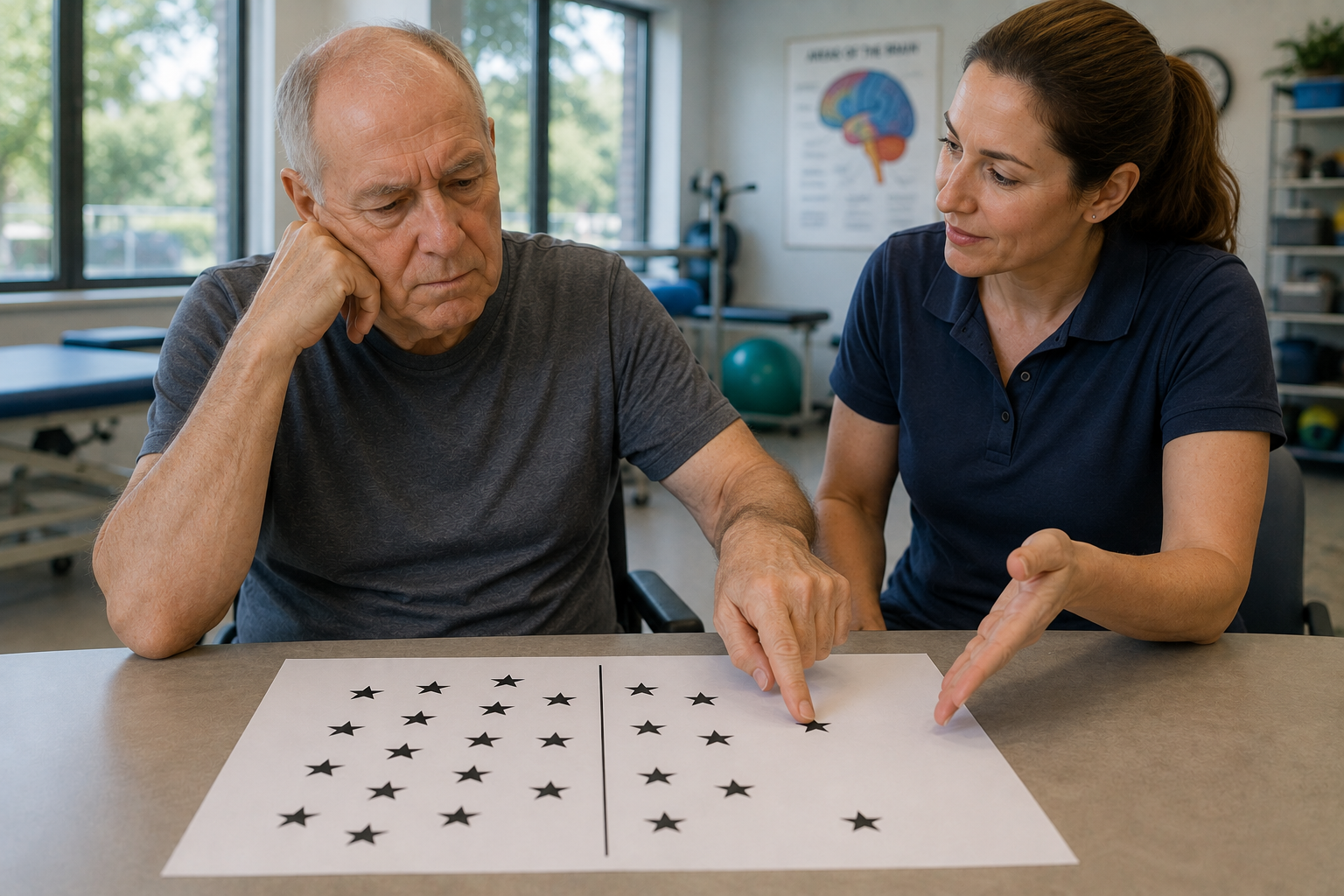
One strategy therapists may use is teaching a person to deliberately scan toward the affected side.
For example, before walking through a doorway, the person may be taught to consciously check both sides.
When reading, they may practice systematically moving their attention across the entire page.
These strategies can become more natural with repetition.
The appropriate approach depends on the individual’s specific neurological deficits.
Why Family Members Shouldn’t Simply Do Everything for Them
It’s understandable for family members to want to prevent mistakes.
But taking over every task can unintentionally reduce opportunities for the person to practice.
Instead, caregivers can often help by:
- Giving the person time to respond
- Providing appropriate reminders
- Keeping important pathways clear
- Encouraging safe scanning strategies
- Following the therapist’s recommendations
The goal is to create a safe environment while still encouraging independence.
Spatial Neglect Can Affect Independence
Something as simple as getting dressed can become complicated when part of the environment or body isn’t being adequately attended to.
That can affect:
- Personal care
- Household activities
- Meal preparation
- Community mobility
- Work or hobbies
- Social activities
Addressing these challenges isn’t just about improving a test score.
It’s about helping the person participate more safely and independently in everyday life.
What Should You Do If You Notice These Signs?
If someone has recently had a stroke and repeatedly misses things on one side, don’t automatically assume they’re being careless or simply need new glasses.
Bring the concern to their rehabilitation or medical team.
A professional evaluation can help determine whether the problem involves:
- Vision
- Spatial attention
- Sensation
- Motor control
- Cognition
- A combination of these factors
Identifying the underlying problem is the first step toward choosing the right rehabilitation strategy.
Recovery Is About More Than Strength and Walking
Stroke rehabilitation isn’t limited to getting stronger or walking farther.
The brain controls how we interact with the world around us.
When a stroke affects attention and awareness, everyday activities can change dramatically—even when someone’s physical strength is improving.
That’s why comprehensive neurological rehabilitation can be so important.
The right therapy can address the specific challenges standing between a person and greater independence.
Schedule a Neurological Rehabilitation Evaluation
📍 Synaptic Rehabilitation
1200 Route 22 East, Suite 4
Bridgewater, NJ 08807
📞 Call: 908-801-6425
If you or someone you love is repeatedly missing objects, bumping into things, or overlooking one side after a stroke, neurological and occupational therapy can help identify the underlying problem and develop strategies for safer, more independent daily activities.
Learn more about neurological rehabilitation and how therapy can help you regain confidence in everyday life.

Steven Cheung, DPT
Steven is the founder and lead physical therapist at SYNAPTIC Rehabilitation. He earned a BS in Exercise Science Applied Kinesiology from Rutgers University in New Brunswick, NJ and his Doctorate degree from American International College in Springfield, MA. Steven specializes in movement disorders such as Parkinson’s disease and many other neurological disorders. Outside of practicing physical therapy Steven enjoys time with his wife, running, and staying active.