
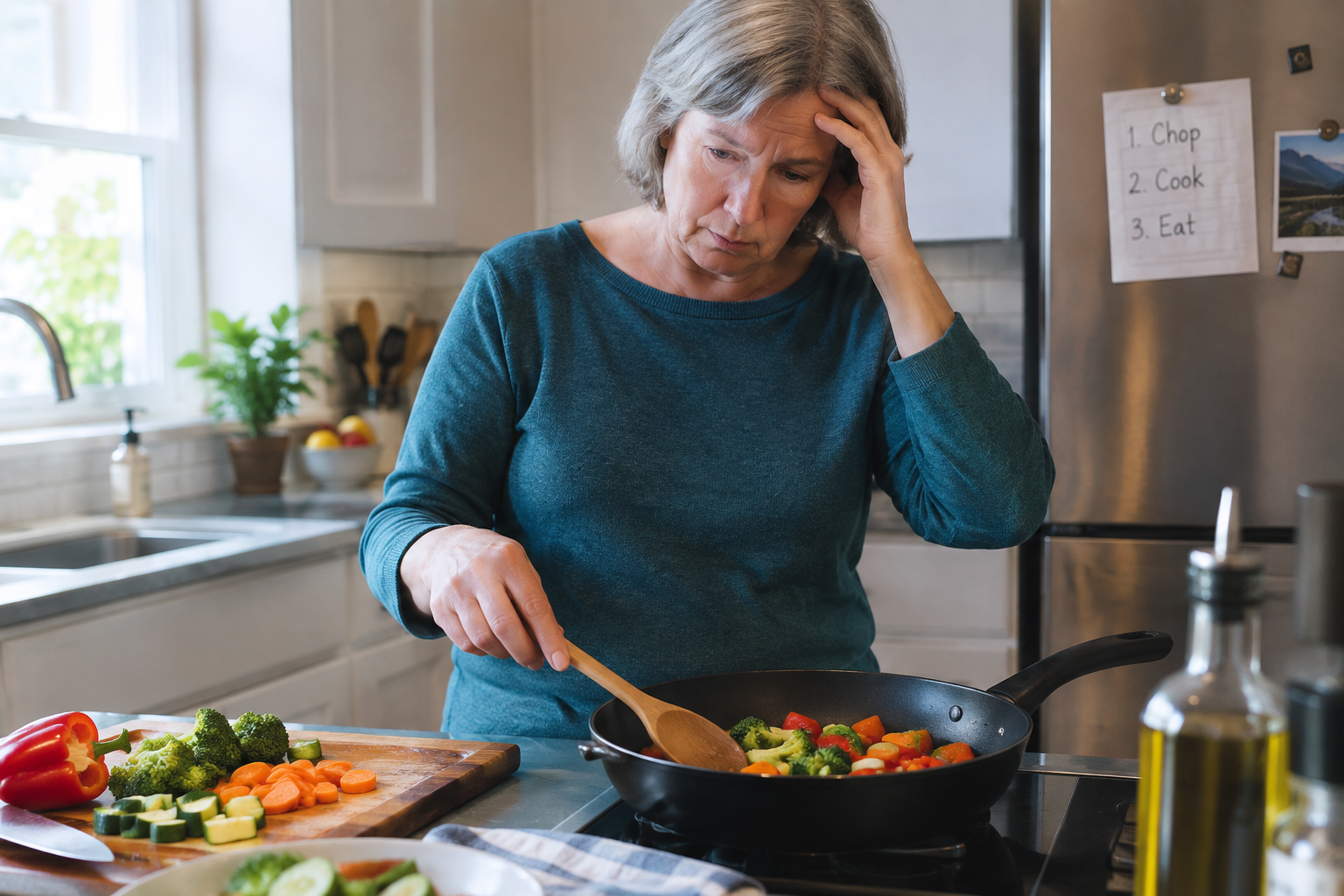
Why Stroke Survivors May Struggle With Cooking More Than They Expect
Cooking is something many people do without thinking much about it. You reach for a pan, open a container, chop vegetables, stir a pot, carry a plate, and move around the kitchen.
After a stroke, those same steps can suddenly feel much harder.
You may have enough strength to lift a pan but struggle to hold it steady with one hand. You may know exactly what you want to make but have trouble organizing all the steps. Standing at the counter for several minutes may leave you feeling unsteady or tired.
These challenges aren’t necessarily about being “weak.” A stroke can affect several skills that cooking requires at the same time.
Why Cooking Can Become Difficult After a Stroke
Cooking combines many physical and thinking skills into one activity.
You may need to:
- Use both hands together
- Reach, grasp, and release objects
- Coordinate small hand movements
- Stand and move safely around the kitchen
- Maintain your balance while reaching
- Judge distances and locations of objects
- Remember several steps in the right order
- Divide your attention between multiple tasks
- Manage fatigue while staying focused
A person may perform well on one of these skills during a therapy exercise but still struggle when they’re all required at once in the kitchen.
That’s one reason everyday activities can feel very different from traditional exercises.
Your Weaker Hand May Get in the Way
Cooking often requires both hands, even when one hand is doing most of the work.
Think about opening a jar. One hand holds the jar while the other twists the lid. Cutting food requires one hand to stabilize the item while the other handles the knife. Pouring from a container may require both hands for control.
After a stroke, the affected hand may have difficulty with:
- Gripping objects securely
- Releasing objects at the right time
- Stabilizing items
- Coordinating movements
- Feeling where the hand is positioned
- Moving quickly enough to keep up with the task
You may start automatically doing everything with your stronger hand. While that can make a task easier in the moment, it may also mean your affected hand gets used less and less during everyday activities.
Occupational therapy can help you work on practical hand use in ways that relate directly to daily activities.
Balance Matters in the Kitchen, Too
The kitchen isn’t always an easy place to move around.
You may need to turn from the counter to the refrigerator, step around an open dishwasher, reach into a cabinet, or carry something from one surface to another.
After a stroke, balance can become more challenging when you’re:
- Reaching outside your normal base of support
- Turning quickly
- Carrying an object
- Standing for a long period
- Moving between different surfaces
- Dividing your attention between walking and another task
This can make cooking feel tiring or unsafe even if you can walk independently.
Therapy can focus on the specific movements you need in your own daily routine rather than treating balance as an isolated skill.
Cooking Also Requires Planning
There’s another part of cooking that isn’t always obvious: sequencing.
Making a simple meal might involve:
- Getting the ingredients out
- Washing and preparing them
- Starting the oven or stove
- Cooking different ingredients at different times
- Monitoring what’s on the stove
- Cleaning up as you go
- Turning everything off when you’re finished
After a stroke, organizing and completing a sequence of steps may take more effort.
You might forget what you were doing after getting another ingredient. You might start one task before finishing another. Or you might become overwhelmed when several things need attention at the same time.
This doesn’t mean you don’t understand how to cook. Your brain may simply be working harder to organize an activity that used to feel automatic.
Fatigue Can Change the Whole Experience
Cooking isn’t just physically demanding. It can also require sustained attention.
You may feel fine when you begin preparing a meal and notice your movements becoming slower or less controlled as you continue.
Fatigue may affect:
- Hand coordination
- Balance
- Concentration
- Reaction time
- Ability to follow multiple steps
- Confidence with more complicated tasks
That’s why a task that feels manageable for five minutes may become much harder after twenty minutes.
Learning how to pace yourself and structure activities around your energy level can be an important part of rehabilitation.
You Don’t Have to Give Up Cooking
Difficulty in the kitchen doesn’t automatically mean you have to stop cooking.
Instead, the goal may be to find safer and more manageable ways to participate.
An occupational therapist may work with you on strategies such as:
- Rearranging frequently used items so they’re easier to reach
- Practicing two-handed activities
- Improving affected-hand coordination
- Using adaptive kitchen equipment when appropriate
- Breaking a recipe into smaller steps
- Practicing standing tolerance
- Improving safe reaching and turning
- Finding ways to conserve energy
- Practicing an actual cooking-related task
The best strategy depends on what specifically is making cooking difficult for you.
Why Real-Life Activities Matter in Occupational Therapy
Occupational therapy isn’t only about exercises.
A therapist may want to understand what you actually need to do at home. If cooking is an important part of your routine, it can become part of the rehabilitation process.
For example, instead of simply practicing grip strength, therapy may address how you use that grip to hold a mixing bowl steady.
Instead of only practicing balance, you may work on safely reaching into a cabinet or turning while carrying an item.
The goal is to connect rehabilitation to the activities that matter in your everyday life.
Small Changes Can Make a Big Difference
You don’t necessarily need to completely change your kitchen or stop preparing your favorite meals.
Sometimes small adjustments can make an activity more manageable.
You might organize your workspace so commonly used items are within easy reach. You might prepare ingredients while seated when appropriate. You might simplify a recipe by completing one step at a time.
Most importantly, don’t assume that struggling with cooking means you’re incapable of doing it.
Your difficulties may reflect changes in movement, coordination, sensation, balance, vision, attention, or planning after your stroke. Those are areas that can be evaluated as part of neurological rehabilitation.
When Should You Consider Occupational Therapy?
If you’re having trouble with cooking, dressing, managing household tasks, using your hands, or other everyday activities after a stroke, an occupational therapy evaluation can help identify what’s getting in the way.
You don’t have to wait until you completely lose your independence.
The right therapy approach can focus on the specific activities you want to return to and help you find practical ways to perform them more safely and efficiently.
Schedule a Neurological Rehabilitation Evaluation
📍 Synaptic Rehabilitation
1200 Route 22 East, Suite 4
Bridgewater, NJ 08807
📞 Call: 908-801-6425
If cooking or other everyday activities have become harder after a stroke, contact Synaptic Rehabilitation to learn how occupational therapy may help you work toward greater independence at home.

Steven Cheung, DPT
Steven is the founder and lead physical therapist at SYNAPTIC Rehabilitation. He earned a BS in Exercise Science Applied Kinesiology from Rutgers University in New Brunswick, NJ and his Doctorate degree from American International College in Springfield, MA. Steven specializes in movement disorders such as Parkinson’s disease and many other neurological disorders. Outside of practicing physical therapy Steven enjoys time with his wife, running, and staying active.