
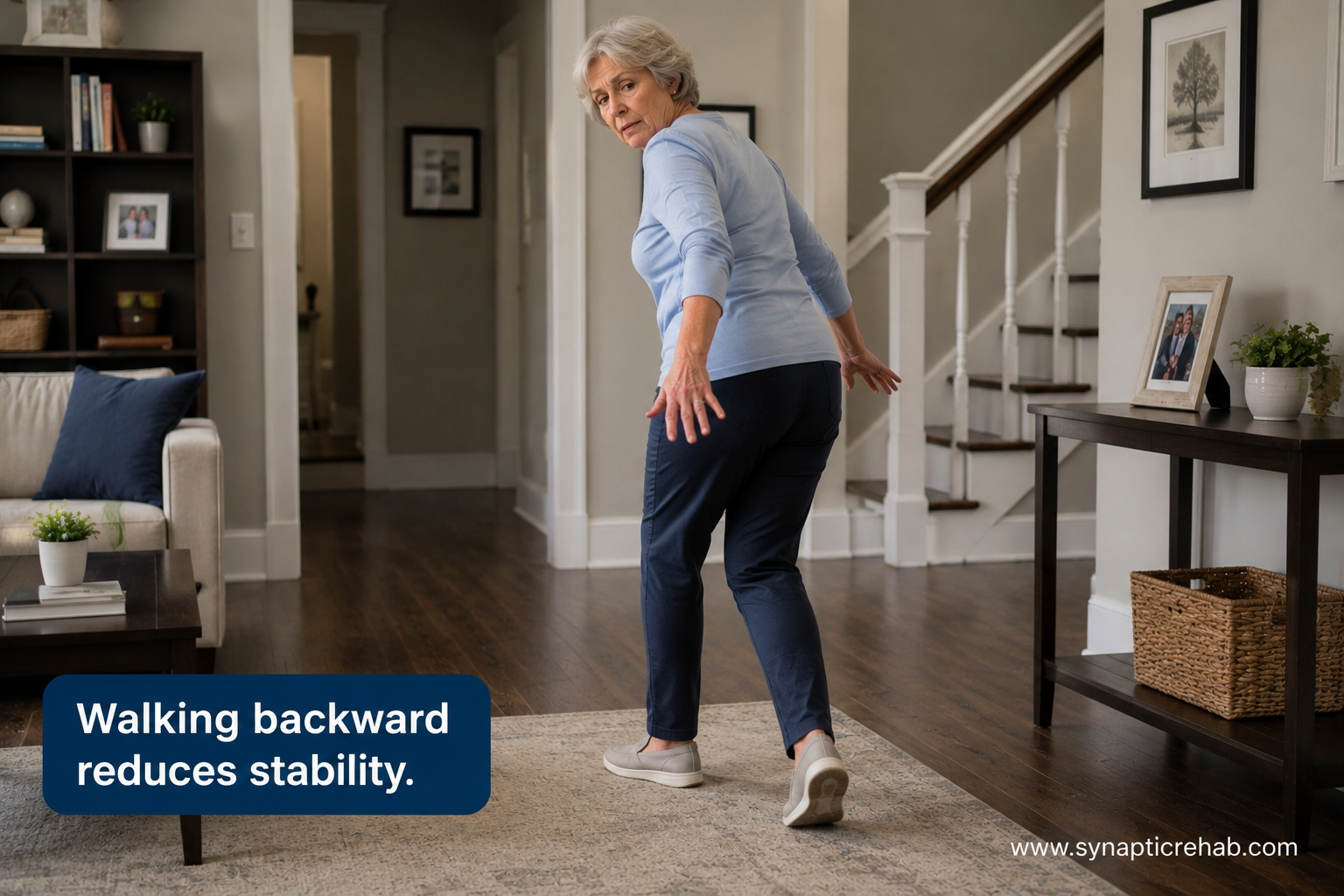
Why Backing Up (Walking Backward) Feels So Unstable
Have you ever stepped backward and suddenly felt unsteady?
Maybe it happened while backing away from a counter.
Stepping away from the sink.
Moving around furniture.
Or getting out of a tight space.
For many people, walking backward feels far more difficult than walking forward.
That’s because backing up requires different balance, coordination, and sensory systems — and it removes many of the cues your body normally relies on to stay stable.
Why Walking Backward Feels Harder
Walking forward is automatic.
Your brain uses:
- Visual information ahead of you
- Predictable movement patterns
- Rhythm and momentum
- Natural arm and leg coordination
Walking backward changes all of that.
Suddenly, your body has to move without seeing where you’re going.
What Makes Walking Backward More Challenging
1. You Lose Visual Guidance
When walking forward, your eyes help guide movement.
Walking backward reduces visual input and forces the brain to rely more on:
- Balance systems
- Sensory feedback from the feet
- Spatial awareness
- Memory of the environment
Without visual guidance, stability becomes harder.
Learn more: https://synapticrehab.com/why-you-feel-more-unsteady-in-dim-lighting-and-what-it-means-for-your-balance/
2. Your Weight Shifts Differently
Backing up requires different body mechanics than forward walking.
It changes:
- Weight transfer
- Foot placement timing
- Balance reactions
- Coordination between the hips and legs
For many people, these movements feel unfamiliar and less controlled.
Learn more: https://synapticrehab.com/why-standing-still-can-be-harder-than-walking-for-some-people/
3. Reaction Time Becomes More Important
Because backward movement is less predictable, your body must react quickly to stay balanced.
Slower reaction time can lead to:
- Missteps
- Hesitation
- Loss of confidence
- Increased fall risk
External source:
https://www.cdc.gov/falls
4. Turning + Backward Movement Increases Risk
Many near-falls happen during combinations of movement.
For example:
- Turning and stepping backward at the same time
- Backing away from a kitchen counter
- Stepping backward to sit down
These movements demand more coordination than most people realize.
Learn more: https://synapticrehab.com/why-turning-is-harder-than-walking-straight-and-how-physical-therapy-helps/
Walking Backward and Parkinson’s Disease
For individuals with Parkinson’s disease, backward stepping may feel especially difficult.
It can contribute to:
- Hesitation before movement
- Freezing episodes
- Smaller, less controlled steps
- Reduced confidence during movement
External source:
https://www.parkinson.org/understanding-parkinsons/movement-symptoms
Learn more: https://synapticrehab.com/services/parkinsons-disease-treatment/
Many people with Parkinson’s notice backward stepping feels slower and less automatic than walking forward.
Common Everyday Situations Where This Happens
- Backing away from a sink or countertop
- Stepping backward into a chair
- Moving around furniture
- Getting out of tight spaces
- Navigating crowded kitchens or bathrooms
These are surprisingly common moments for loss of balance.
Learn more: https://synapticrehab.com/why-doorways-and-narrow-spaces-increase-fall-risk/
Signs This May Be Affecting Your Balance
- Feeling nervous stepping backward
- Taking very small or hesitant backward steps
- Needing support when backing up
- Feeling less stable during transitions
These are early signs your balance system may need additional support.
Learn more: https://synapticrehab.com/how-physical-therapy-helps-you-regain-confidence-after-a-near-fall/
How Physical Therapy Helps
1. Dynamic Balance Training
Improves stability during movement changes and direction shifts.
2. Gait Retraining
Builds smoother coordination during forward and backward stepping.
Learn more: https://synapticrehab.com/how-physical-therapy-can-help-improve-gait-and-balance-as-you-age/
3. Functional Movement Practice
Includes real-world activities like stepping backward safely around furniture or into chairs.
4. Parkinson’s-Specific Movement Strategies
Cueing and movement training help improve confidence and reduce hesitation.
Learn more: https://synapticrehab.com/parkinsons-disease-physical-therapy-in-bridgewater-nj/
Backward Movement Shouldn’t Feel Unsafe
Walking backward may seem like a small movement, but it places big demands on balance.
If backing up feels unstable or stressful, it may be a sign your body needs better coordination, confidence, and movement control.
Schedule a Balance & Mobility Evaluation
📍 Synaptic Rehabilitation
1200 Route 22 East, Suite 4
Bridgewater, NJ 08807
📞 Call: 908-801-6425
If stepping backward feels unstable or unpredictable, physical therapy can help improve balance, movement confidence, and safety in everyday life.

Steven Cheung, DPT
Steven is the founder and lead physical therapist at SYNAPTIC Rehabilitation. He earned a BS in Exercise Science Applied Kinesiology from Rutgers University in New Brunswick, NJ and his Doctorate degree from American International College in Springfield, MA. Steven specializes in movement disorders such as Parkinson’s disease and many other neurological disorders. Outside of practicing physical therapy Steven enjoys time with his wife, running, and staying active.